


American scientists simplify production of phaeocaulisin A
Published May 12 - 2025
The development of modern pharmaceuticals and synthetic drugs for cancer treatment requires the constant creation of new molecules with high biological activity. However, synthesising such substances is a complex and expensive process. One promising compound is phaeocaulisin A, a guaianolide sesquiterpene found in a specific species of ginger plant (Curcuma phaeocaulis) that exhibits potent anti-cancer activity. The synthesis method developed by Emory University researchers significantly reduces the number of stages in the production process and offers a new approach to carbonylation reactions using a palladium catalyst.

Emory University (Image: Emory University)
This development has two significant implications: it increases the range of methods for synthesising complex natural compounds, thereby reducing production costs and making promising drugs more accessible. Secondly, it strengthens the position of palladium catalysts in the medical and pharmaceutical industries by demonstrating their pivotal role in transforming organic molecules. Thus, the development of a new method for synthesising phaeocaulisin A has significant commercial implications, becoming an important element in the development of the market for innovative drugs.
Phaeocaulisin A has attracted the attention of the scientific community thanks to its unique 8-oxabicyclo[3.2.1]octane cored. According to research, this core plays a key role in the compound’s biological activity. A detailed study of this compound’s structure and how it acts in the body could lead to new antitumour and immunomodulatory drugs.
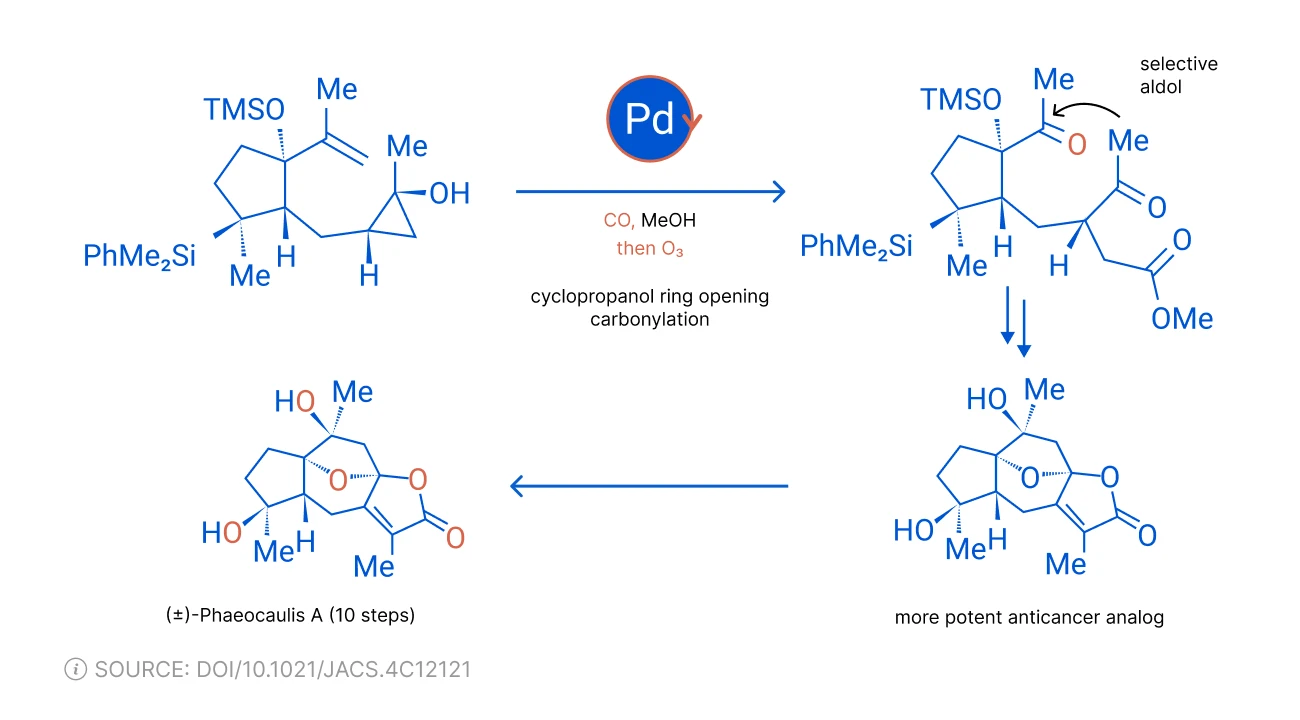
Chemists at Emory University have proposed an innovative approach to synthesising phaeocaulisin A, based on a palladium-catalysed carbonylation reaction. Traditional methods of producing phaeocaulisin A required 17 steps and achieved a final yield of just 2%, rendering the process economically unfeasible. The new method reduces the number of steps to ten, while increasing the product yield to 3.8%.
A key element of the innovative carbonylation method was the use of a palladium catalyst to efficiently construct the critical γ-ketoester fragment. Consequently, the number of synthesis stages could be significantly reduced and the yield of the target product increased. Sequential cascade transformations then ensured the formation of the complex tetracyclic structure characteristic of phaeocaulisin A, thus confirming the effectiveness of the proposed approach. This sequential transformation process improved the efficiency of the synthesis and confirmed the potential of directed carbonylation in the presence of palladium as a promising organic synthesis method.
Additionally, an intermediate product containing an α-methylene γ-butyrolactone fragment was isolated during the studies. This demonstrated antiproliferative activity against breast cancer cells (HER2+ and triple-negative subtypes). This indicates the potential for creating a new class of pharmacological compounds based on similar structural fragments.
The developed method is important for both the pharmaceutical and chemical industries, as it demonstrates the potential of palladium catalysts in simplifying complex, multistage synthetic processes. Introducing such an approach into production would significantly reduce the cost of promising drugs, opening up new possibilities for developing effective anti-cancer and immunomodulatory agents.
Source: https://phys.org/news/2025-02-chemistry-early-triple-negative-breast.html
https://pubs.acs.org/doi/10.1021/jacs.4c12121
Recent News

October 09 - 2025
Ivanhoe Mines, a Canadian mining and exploration company known for several high-profile discoveries, has driven underground development into the high-grade Platreef orebody for the first time. The company’s Executive Co-Chair Robert Friedland and President and Chief Executive Officer Marna Cloete detailed the breakthrough, with mining crews entering the orebody at the 850-metre level with the first blast of high-grade ore in early May.

September 24 - 2025
Canadian exploration company Power Metallic has reported results from its deepest intersection to date at the Lion Zone, carried out in the wake of successful exploration activities last year. The 2024 discovery of the zone, 5.5 kilometres away from the Nisk Main Zone, has shifted the company’s focus towards what could prove a game-changing discovery.

September 05 - 2025
Australian mining company Southern Palladium has received an environmental authorization (EA) on its flagship Tier 1 Bengwenyama project from South Africa’s Department of Mineral and Petroleum Resources (DMPR). The license outlines rights on underground mining and related infrastructural activities on the project, marking a key milestone towards development.

August 25 - 2025
A study from a team of chemists working at McGill University in Montreal, Canada has proposed a new method for synthesising palladium catalysts using electrochemical potential, supporting both oxidative addition and reductive elimination with two-electron exchange in mild temperature and pressure conditions.

August 05 - 2025
A team of functional materials researchers in China developed a copper–palladium catalyst that has been shown to improve catalytic activity and selectivity in the electrochemical nitrate reduction reaction (NO3RR), leading to improved ammonia yields. Scaling this process could significantly reduce the energy and environmental burden of the ammonia industry as a whole.

July 21 - 2025
Zhe Gong et al. from the China University of Geosciences and Zhiping Deng and Xiaolei Wang from the University of Alberta (Canada) have developed a highly efficient palladium catalyst that could support the large-scale rollout of hydrogen fuel cells. The catalyst was designed by doping palladium with cobalt producing atomic cobalt (Co)-doped Pd metallene (Co-Pdene), and demonstrated exceptional electrocatalytic performance while maintaining its structural integrity.