


Copper–palladium catalyst shows high efficiency in green ammonia production
Published August 05 - 2025

Natural Science Foundation of China (NSFC). Image: NSFC
A team of functional materials researchers in China developed a copper–palladium catalyst that has been shown to improve catalytic activity and selectivity in the electrochemical nitrate reduction reaction (NO3RR), leading to improved ammonia yields. Scaling this process could significantly reduce the energy and environmental burden of the ammonia industry as a whole.
At present, the large-scale production of NH3 relies on the Haber–Bosch process, which requires high-temperature and high-pressure conditions while consuming significant quantities of fossil fuels and emitting large amounts of greenhouse gases. Given the importance of ammonia as a chemical feedstock in fertilisers, pharmaceuticals, textiles and other industries, there is significant incentive to improve efficiency and address externalities in the production of ammonia. It is thanks to advances in electrochemical technologies that the reduction reaction has emerged as a viable alternative.
NO3RR is an environmentally friendly method of reducing nitrates to ammonia, and holds major potential for sustainable management of the nitrogen cycle and the green production of ammonia. It can be driven by renewable electricity, and utilises nitrate byproducts from other human activities. If it can be scaled up, the process could make a significant contribution to addressing nitrate pollution.
Identifying potential catalysts that could provide high Faradaic efficiency (FE) and ammonia yield has proven to be an obstacle to the large-scale application of NO3RR. Recent studies have favoured transition metals such as copper, cobalt and nickel, as well as noble metals including ruthenium, silver and palladium. Copper has shown strong NO3− activation capacity, though in isolation it is characterised by excessive NO2− production and relatively low FE and yield. Palladium exhibits good adsorption–desorption characteristics, and is regarded as an efficient electrocatalyst.
In the recent study, the team prepared a self-supported nanoporous bimetallic copper and palladium-based catalyst (Cu–Pd@ZrCuAl) through dealloying and galvanic replacement. This structure provides a large surface area and unique electronic properties, essential for high catalytic activity. It was shown that the addition of just a tiny amount of palladium enhanced H2O dissociation, providing sufficient H atoms for the hydrogenation of nitrate to produce NH3, while suppressing the competing hydrogen evolution reaction and reducing NO2 accumulation. An outstanding FE of 95% was achieved, with an impressive NH3 yield rate approx. 10% higher in comparison to other bimetallic catalysts.
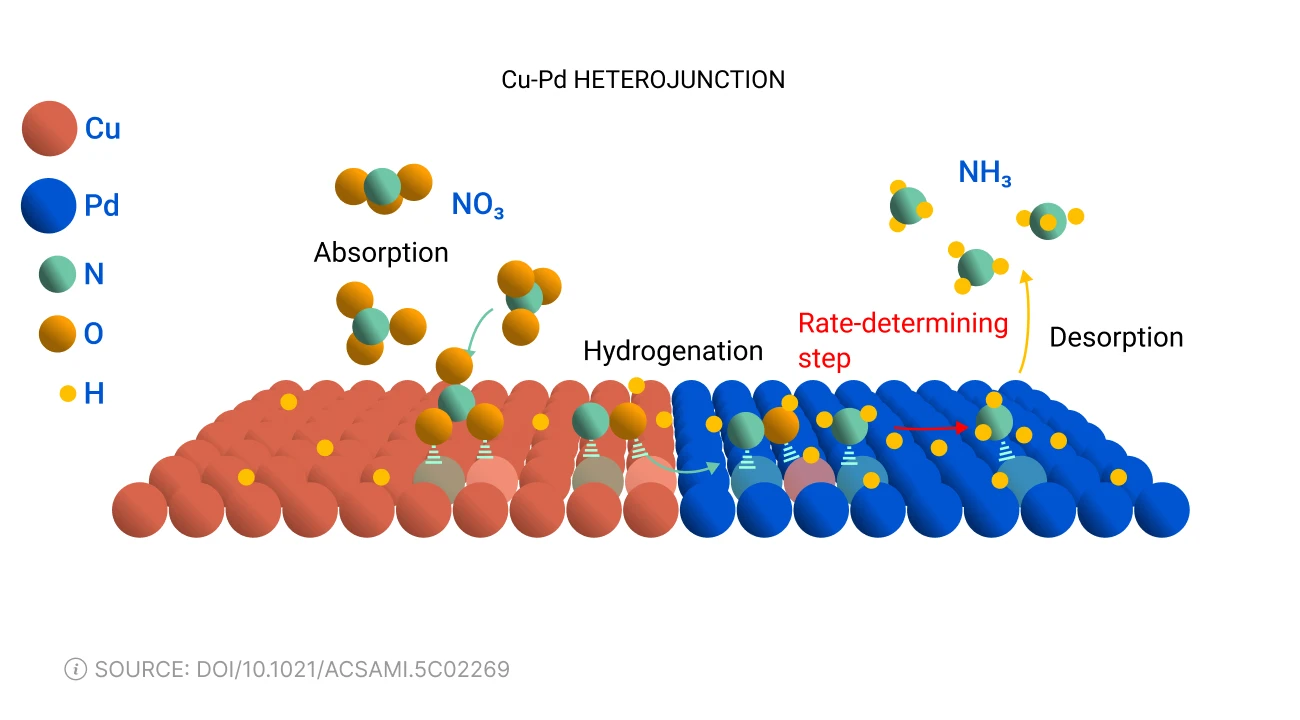
The authors theorised that the Cu–Pd heterostructure modifies the electronic structure of the copper such that the adsorption behaviour of the intermediates is optimised and the energy barrier of the rate-determining step (RDS) – the ammonia desorption – is reduced. In practice this means that the Cu–Pd@ZrCuAl electrocatalyst is highly effective in the reduction of nitrate to ammonia, and is therefore able to provide rapid ammonia generation. The catalyst also shows outstanding long-term stability.
Looking ahead, ammonia is also viewed as a promising potential energy carrier, and its emissions-free production could support efforts to advance the energy transition and adopt a circular economy.
The authors of the study are all representatives of the State Key Laboratory of Precious Metal Functional Materials, the Tianjin Key Laboratory of Composite and Functional Materials and the School of Materials Science and Engineering, all of which are based in Tianjin, China. Support for the project was provided by the National Natural Science Foundation of China.
Recent News
October 09 - 2025
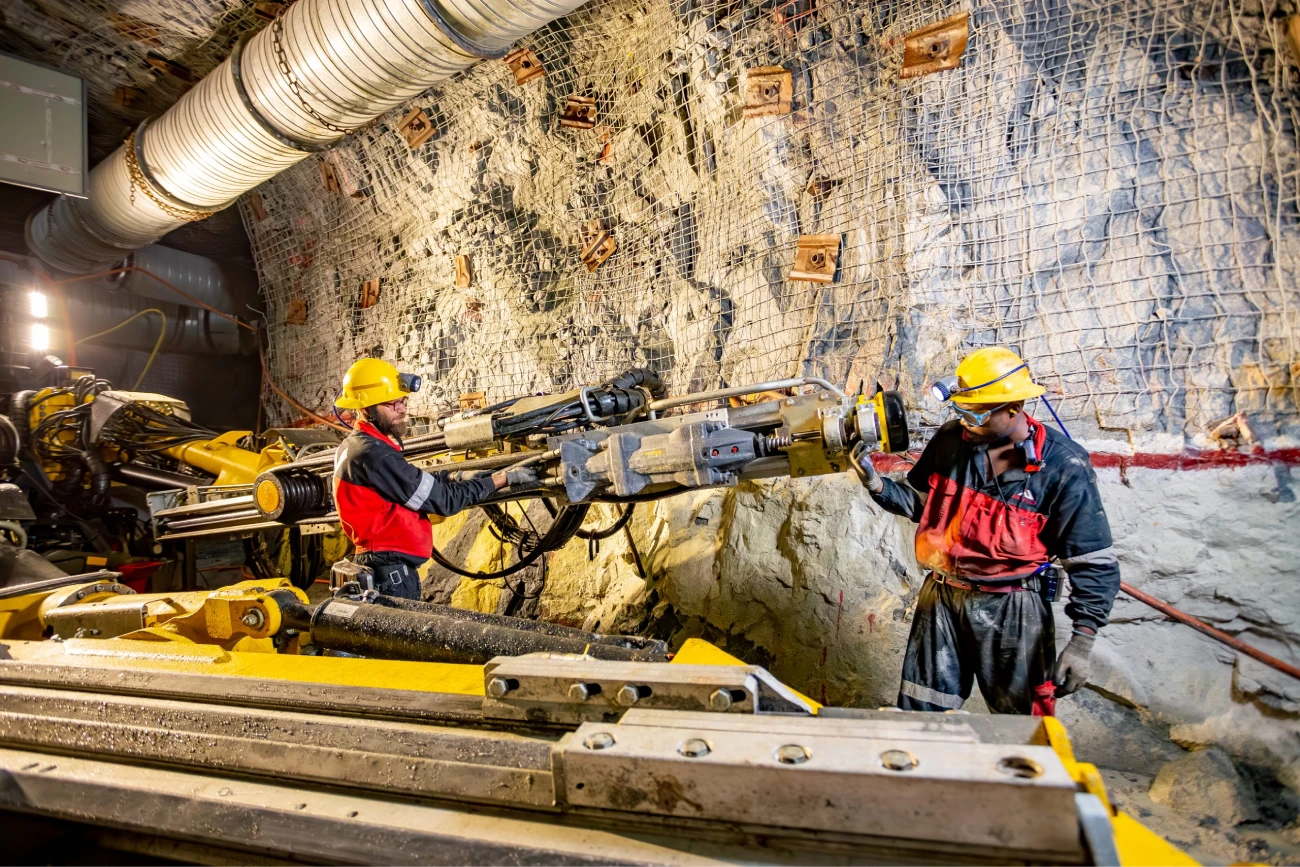
Ivanhoe Mines, a Canadian mining and exploration company known for several high-profile discoveries, has driven underground development into the high-grade Platreef orebody for the first time. The company’s Executive Co-Chair Robert Friedland and President and Chief Executive Officer Marna Cloete detailed the breakthrough, with mining crews entering the orebody at the 850-metre level with the first blast of high-grade ore in early May.

September 24 - 2025
Canadian exploration company Power Metallic has reported results from its deepest intersection to date at the Lion Zone, carried out in the wake of successful exploration activities last year. The 2024 discovery of the zone, 5.5 kilometres away from the Nisk Main Zone, has shifted the company’s focus towards what could prove a game-changing discovery.

September 05 - 2025
Australian mining company Southern Palladium has received an environmental authorization (EA) on its flagship Tier 1 Bengwenyama project from South Africa’s Department of Mineral and Petroleum Resources (DMPR). The license outlines rights on underground mining and related infrastructural activities on the project, marking a key milestone towards development.

August 25 - 2025
A study from a team of chemists working at McGill University in Montreal, Canada has proposed a new method for synthesising palladium catalysts using electrochemical potential, supporting both oxidative addition and reductive elimination with two-electron exchange in mild temperature and pressure conditions.

July 21 - 2025
Zhe Gong et al. from the China University of Geosciences and Zhiping Deng and Xiaolei Wang from the University of Alberta (Canada) have developed a highly efficient palladium catalyst that could support the large-scale rollout of hydrogen fuel cells. The catalyst was designed by doping palladium with cobalt producing atomic cobalt (Co)-doped Pd metallene (Co-Pdene), and demonstrated exceptional electrocatalytic performance while maintaining its structural integrity.

July 11 - 2025
A team of researchers at the University of Milan has developed a new method to speed up the hydrogenation and dehydrogenation of magnesium nanoparticles that could significantly improve the efficiency of hydrogen storage and support easier scaling up the technology.