


Home NewsElectrifying palladium-catalyzed reactions broaden electrochemical methods in synthetic chemistry
NewsElectrifying palladium-catalyzed reactions broaden electrochemical methods in synthetic chemistry Electrifying palladium-catalyzed reactions broaden electrochemical methods in synthetic chemistry
Published August 25 - 2025
A study from a team of chemists working at McGill University in Montreal, Canada has proposed a new method for synthesising palladium catalysts using electrochemical potential, supporting both oxidative addition and reductive elimination with two-electron exchange in mild temperature and pressure conditions.

McGill University in Montreal. Image: Wikimedia Commons (D. Benjamin Miller)
Palladium has enjoyed a major role in modern organic synthesis, and is a popular catalyst in bond-forming reactions such as carbonylations with feedstock reagents, whereby a carbon monoxide molecule is incorporated into a substrate. A one of the obstacles to scalability in these reactions, however, is the need for catalyst regeneration and keeping a stability. These balancing operations, in which steps on the path to product formation must be reversed, often require high temperature conditions and can limit the scope of application.
Electrochemistry is enjoying renewed popularity at present, thanks to its ability to create sustainable transformations, particularly in oxidative and reductive reactions. Redox neutral reactions – those which do not require an external agent for reduction or oxidation – have been less well researched, though there is significant potential for the deployment of electrochemistry here. The researchers proposed driving catalysis using electrochemical potential, using two-electron cycling during the metal oxidation state. This is possible with the use of metal complexes that favour two-electron changes, and the electrochemical potential serves as the energy source as opposed to oxidising and reducing substrates or a thermal catalyst.
The abovementioned redox steps support carbonylation reactions at very mild ambient temperature and pressure conditions. One such reaction is the catalytic synthesis of high-energy aroyl halide electrophiles. It was also shown that the catalyst functions according to a multi-electron exchange pathway, where two-electron reduction drives oxidative addition, and two-electron oxidation leads to reductive product elimination. The combination of these two processes is described by the authors as unique. In addition to using electrochemical potential energy as the only additional energy source, this process eliminates the need for the classic ligand balanced thermal operations.
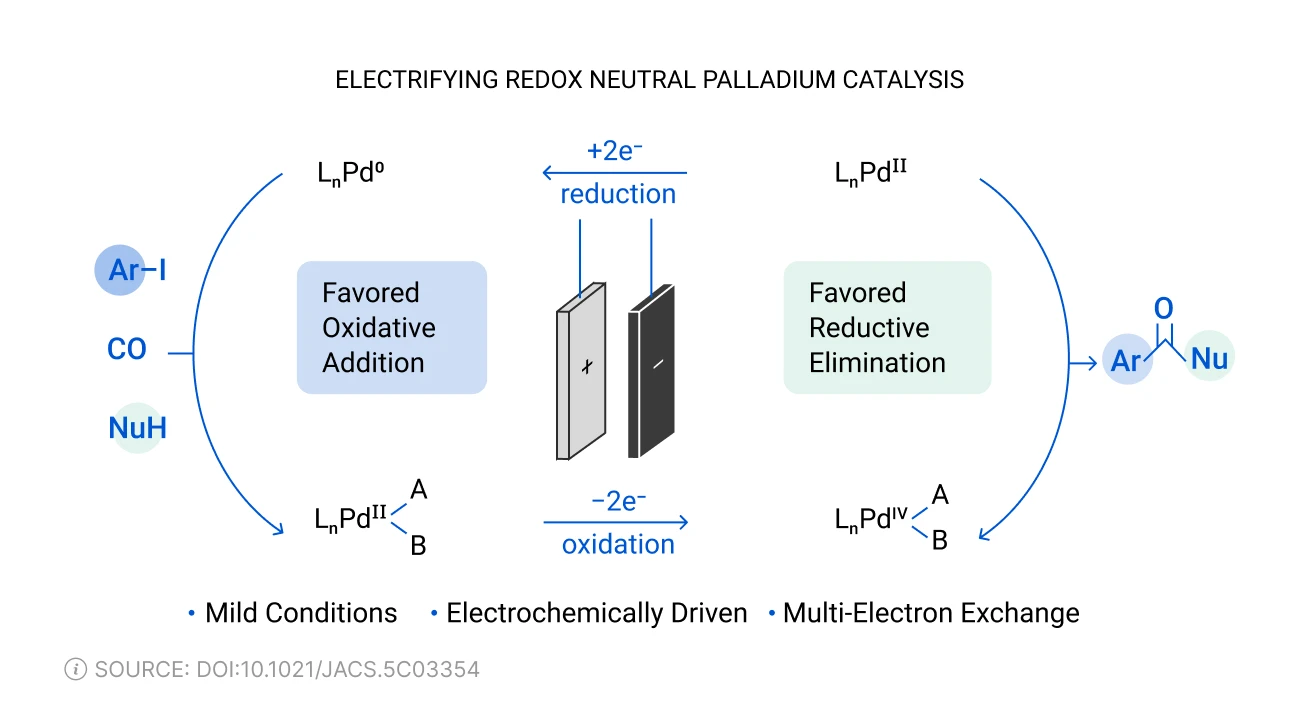
In the experiment, the researchers examined the carbonylative synthesis of acyl chlorides, in environmental conditions of up to 130 °C and 50 atm CO. Palladium is well suited for this type of reaction, as it favours two-electron oxidation state changes more strongly relative to nickel. The presence of carbon monoxide can also stabilise palladium through various states of oxidation.
According to the authors, this form of electrocatalysis facilitated by multi-electron exchange has wide-ranging potential applications in the chemical and pharmaceutical industries. Furthermore, the ability to carry out oxidative addition and reductive elimination with low environmental barriers opens the door to more complex bond-forming reactions. The findings could prove to be an important milestone in the drive to electrify catalytic synthesis.
The authors of the study are all based at McGill University’s Department of Chemistry in Montreal, Canada. The work was carried out with a Natural Sciences and Engineering Research Council of Canada Discovery Grant, a McGill Sustainable Systems Initiative Ideas Grant and a Molson & Hilton Hart Fellowship, in addition to support from the Centre in Green Chemistry and Catalysis.
Recent News

October 09 - 2025
Ivanhoe Mines, a Canadian mining and exploration company known for several high-profile discoveries, has driven underground development into the high-grade Platreef orebody for the first time. The company’s Executive Co-Chair Robert Friedland and President and Chief Executive Officer Marna Cloete detailed the breakthrough, with mining crews entering the orebody at the 850-metre level with the first blast of high-grade ore in early May.

September 24 - 2025
Canadian exploration company Power Metallic has reported results from its deepest intersection to date at the Lion Zone, carried out in the wake of successful exploration activities last year. The 2024 discovery of the zone, 5.5 kilometres away from the Nisk Main Zone, has shifted the company’s focus towards what could prove a game-changing discovery.

September 05 - 2025
Australian mining company Southern Palladium has received an environmental authorization (EA) on its flagship Tier 1 Bengwenyama project from South Africa’s Department of Mineral and Petroleum Resources (DMPR). The license outlines rights on underground mining and related infrastructural activities on the project, marking a key milestone towards development.

August 05 - 2025
A team of functional materials researchers in China developed a copper–palladium catalyst that has been shown to improve catalytic activity and selectivity in the electrochemical nitrate reduction reaction (NO3RR), leading to improved ammonia yields. Scaling this process could significantly reduce the energy and environmental burden of the ammonia industry as a whole.

July 21 - 2025
Zhe Gong et al. from the China University of Geosciences and Zhiping Deng and Xiaolei Wang from the University of Alberta (Canada) have developed a highly efficient palladium catalyst that could support the large-scale rollout of hydrogen fuel cells. The catalyst was designed by doping palladium with cobalt producing atomic cobalt (Co)-doped Pd metallene (Co-Pdene), and demonstrated exceptional electrocatalytic performance while maintaining its structural integrity.

July 11 - 2025
A team of researchers at the University of Milan has developed a new method to speed up the hydrogenation and dehydrogenation of magnesium nanoparticles that could significantly improve the efficiency of hydrogen storage and support easier scaling up the technology.