


Innovative use of ligands and palladium set to reduce drug production costs
Published May 29 - 2025
The pharmaceutical industry is constantly working to produce more effective and affordable medications. One of the most promising areas of drug development in this regard is the use of catalysts in synthesising active substances. Catalysis can significantly increase the efficiency of synthesising complex molecules. New research conducted at the University of Missouri, USA represents a breakthrough in this field. The development of the AshPhos ligand in combination with palladium has led to the creation of a catalyst that paves the way for the cheaper production of a wide range of pharmaceutical compounds.

University of Missouri (Image: University of Missouri)
This approach reduces the cost of drugs and expands the possibilities of organic synthesis, solving several long-standing problems associated with the Buchwald–Hartwig reaction. Using a palladium-based catalyst and a new ligand overcomes the limitations associated with the low reactivity of certain classes of compounds. This opens up new prospects for creating the complex molecular structures needed in modern medicine, thereby reinforcing the importance of palladium catalysts in modern organic synthesis.
The AshPhos ligand was developed as an alternative to the highly reactive GPhos ligand, which requires significant synthesis costs. The starting material for AshPhos is 6,7-dibromo-2,3-dihydrobenzo[b][1,4]dioxin. Its structural features allow for the addition of a phosphine group in the para position relative to one ether group, and an electron-rich aryl ring in the para position relative to the second ether group and the ortho position relative to the phosphine group. These modifications significantly expand the potential applications of AshPhos in Buchwald–Hartwig amination reactions.
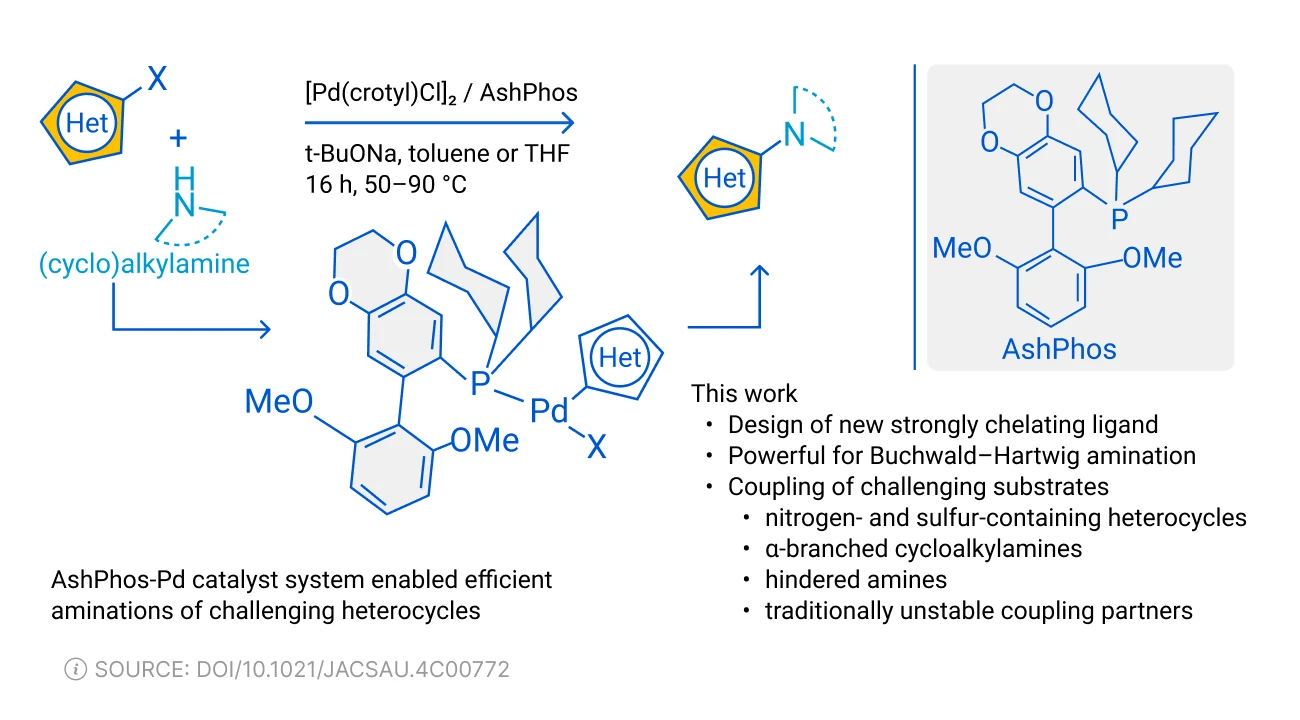
Using a palladium catalyst with an AshPhos ligand enhances chelation, simplifying the oxidative addition and transmetalation processes. This ensures effective amination, even of complex substrates that have previously demonstrated low reactivity. The study tested various palladium catalysts, including [Pd(crotyl)Cl]₂, Pd(OAc)₂, Pd₂dba₃, [Pd(allyl)Cl]₂ and Pd(cod)Cl₂. The best results were obtained with the [Pd(crotyl)Cl]₂ catalyst, which produced a target product yield of 90%. Using Pd2dba3 instead reduced the yield to 70%, while using Pd(OAc)2 reduced it further to 38%.
Thus, the development of AshPhos and its use in combination with palladium represents a significant step forward in organic synthesis and pharmaceutical production. This new technology reduces the cost of drug production and expands the possibilities for using palladium catalysts, which is important in the long term for both the scientific community and business.
Source:
https://medicalupdateonline.com/2025/02/mizzou-researchers-invent-a-new-tool-to-help-lower-the-cost-of-tomorrows-medicine/
https://pubs.acs.org/doi/10.1021/jacsau.4c00772
Recent News

October 09 - 2025
Ivanhoe Mines, a Canadian mining and exploration company known for several high-profile discoveries, has driven underground development into the high-grade Platreef orebody for the first time. The company’s Executive Co-Chair Robert Friedland and President and Chief Executive Officer Marna Cloete detailed the breakthrough, with mining crews entering the orebody at the 850-metre level with the first blast of high-grade ore in early May.

September 24 - 2025
Canadian exploration company Power Metallic has reported results from its deepest intersection to date at the Lion Zone, carried out in the wake of successful exploration activities last year. The 2024 discovery of the zone, 5.5 kilometres away from the Nisk Main Zone, has shifted the company’s focus towards what could prove a game-changing discovery.

September 05 - 2025
Australian mining company Southern Palladium has received an environmental authorization (EA) on its flagship Tier 1 Bengwenyama project from South Africa’s Department of Mineral and Petroleum Resources (DMPR). The license outlines rights on underground mining and related infrastructural activities on the project, marking a key milestone towards development.

August 25 - 2025
A study from a team of chemists working at McGill University in Montreal, Canada has proposed a new method for synthesising palladium catalysts using electrochemical potential, supporting both oxidative addition and reductive elimination with two-electron exchange in mild temperature and pressure conditions.

August 05 - 2025
A team of functional materials researchers in China developed a copper–palladium catalyst that has been shown to improve catalytic activity and selectivity in the electrochemical nitrate reduction reaction (NO3RR), leading to improved ammonia yields. Scaling this process could significantly reduce the energy and environmental burden of the ammonia industry as a whole.

July 21 - 2025
Zhe Gong et al. from the China University of Geosciences and Zhiping Deng and Xiaolei Wang from the University of Alberta (Canada) have developed a highly efficient palladium catalyst that could support the large-scale rollout of hydrogen fuel cells. The catalyst was designed by doping palladium with cobalt producing atomic cobalt (Co)-doped Pd metallene (Co-Pdene), and demonstrated exceptional electrocatalytic performance while maintaining its structural integrity.