


New advances in chain-growth polymerization using palladium intermediates
Published June 24 - 2025
A team of researchers at Peking University has achieved stable chain-growth polymerization using propargyl/allenyl palladium intermediates, making it possible to synthesize complex polymers in a new way. The research was carried out by Zheng-Lin Wang and Rong Zhu as part of a joint project, with support from Beijing National Laboratory of Molecular Sciences (BNLMS), Key Laboratory of Bioorganic Chemistry and Molecular Engineering of Ministry of Education, College of Chemistry and Molecular Engineering.
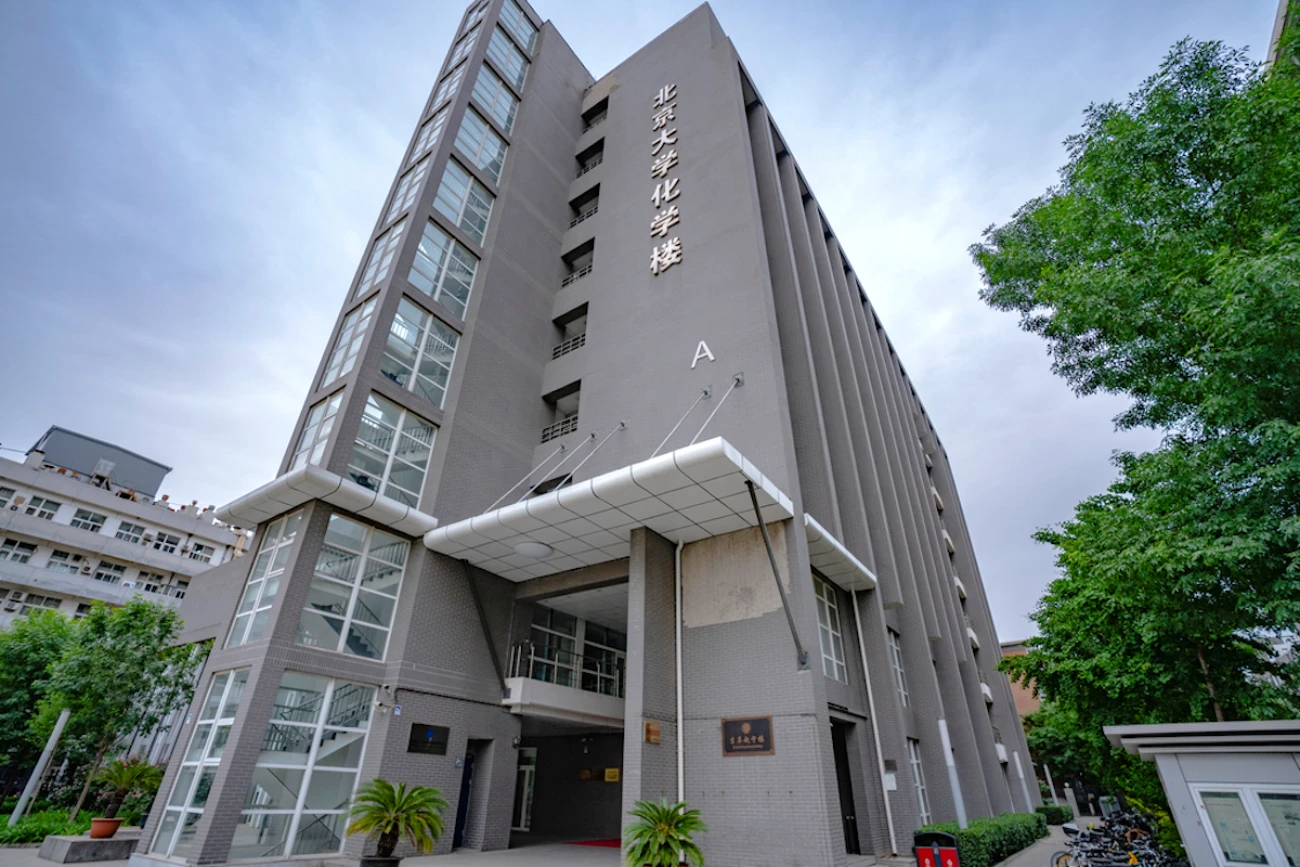
College of Chemistry and Molecular Engineering. Image: Wikimedia.Commons
Chain-growth polymerization is a polymerization technique whereby monomer molecules are added one by one to a chain. First elaborated in the 1950s, this method is used to create a number of polymers with wide-ranging applications such as polyethylene (PE), polypropylene (PP) and polyvinyl chloride (PVC).
Since the late 1980s, synthetic organic chemistry has found numerous applications for substitution reactions involving allylic electrophiles that use a palladium catalyst. While they are structurally similar, catalysis using propargyl/allenyl electrophiles has been studied to a lesser extent. One possible explanation for this is that the additional π-bond in the intermediate drastically increases the complexity of the reaction.
While π-allyl catalysis always leads to allylation, nucleophilic trapping (an electron-rich species reacting with an intermediate) in propargyl/allenyl systems can occur via three palladium complexes, bringing associated changes to the substrate-catalyst combination. The σ-allenyl complex leads to allenylation (type A), the π-propargyl causes alkenylation (type B), and the σ-propargyl (type C) palladium complex brings about propargylation.
The main goal of the study was to overcome type B trapping, a side process that interrupts chain growth in polymerization using propargyl/allenyl electrophiles. In this scenario, the intermediate forms a π-propargyl palladium complex (type B), which is then rapidly consumed in side reactions — such as a second nucleophilic attack or β-hydride elimination — rather than continuing the polymer chain. While type B trapping is a common and often efficient pathway in palladium catalysis, it prevents the controlled addition of monomers required for chain-growth polymerization. The researchers identified a special allenylic electrophile known as vinylidenecyclopropane 1,1-dicarboxylate (VDCP) as a potential solution to the difficulty of supporting chain-growth reactions. The chemical can be synthesised in two steps from two widely available commodity chemicals: butyne-1,4-diol and malonate.
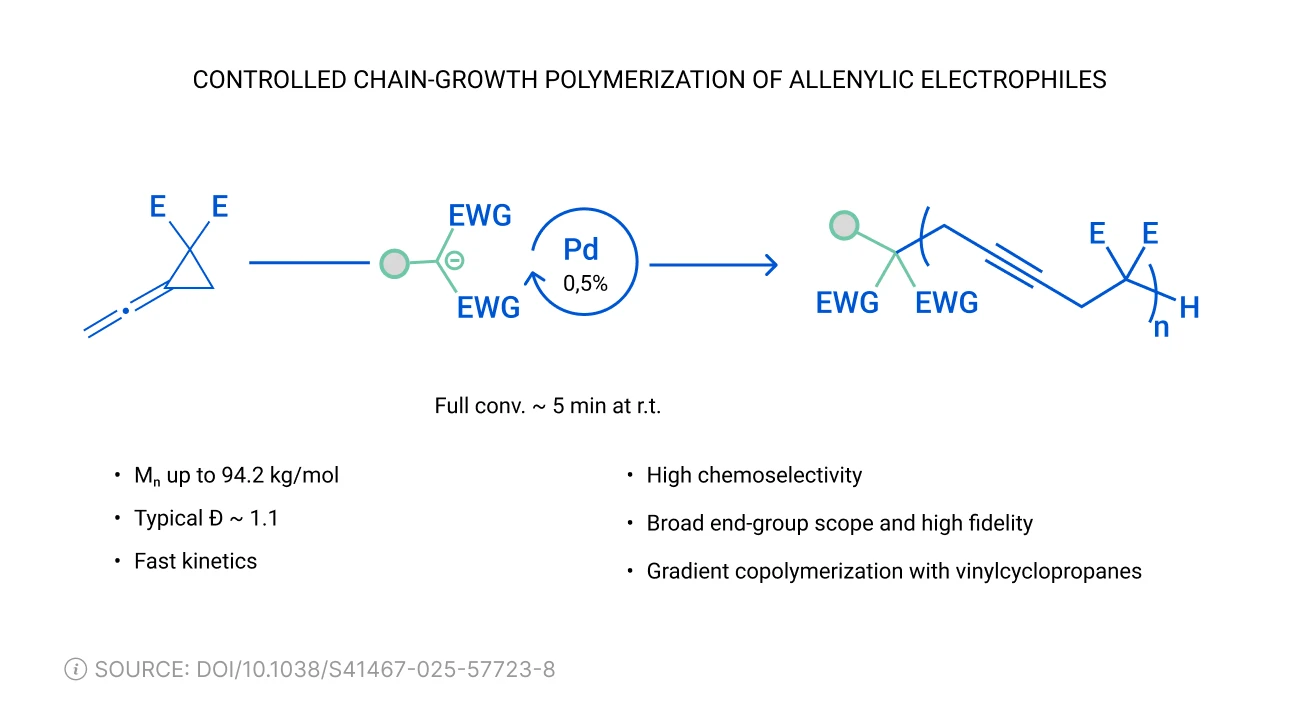
Experimental and computational evidence showed support for propargyl/allenyl palladium intermediates. Controlled ring-opening polymerization was achieved with the palladium catalyst, and VDCP selectively reacted via the σ-allenyl palladium complex (type A) as opposed to the more common π-propargyl pathway (type B). The material’s exceptional reactivity supported the precise synthesis of alkyne-backbone polymers, and the researchers were able to demonstrate the preparation of unsaturated macromolecules with advanced sequences and architectures
Palladium is a platinum group metal (PGM) prized across numerous industries for its unique applications, including its catalytic properties. Pd is one of the important metals in organic chemistry, where it is one of the most commonly used catalysts. This is the result of its unique ability to support the controlled formation of certain bonds, such as carbon–carbon (C–C) and carbon–heteroatom bonds, i.e. those involving heteroatoms such as nitrogen, oxygen and sulphur.
Complex polymers such as the aforementioned PE, PP and PVC have long been some of the most important synthetic polymers in the world, thanks to their cost-effectiveness, durability and versatility. They are used in piping, containers, insulation, consumer appliances, medical devices, fabrics, construction materials and much more. More recently, research is underway on new applications in the green economy. Conjugated polymers are a key material in organic photovoltaic cells, as well as a new generation of batteries and semiconductors. While these technologies are at an early stage, they could potentially make cutting-edge renewable technologies significantly more durable and affordable.
Recent News

October 09 - 2025
Ivanhoe Mines, a Canadian mining and exploration company known for several high-profile discoveries, has driven underground development into the high-grade Platreef orebody for the first time. The company’s Executive Co-Chair Robert Friedland and President and Chief Executive Officer Marna Cloete detailed the breakthrough, with mining crews entering the orebody at the 850-metre level with the first blast of high-grade ore in early May.

September 24 - 2025
Canadian exploration company Power Metallic has reported results from its deepest intersection to date at the Lion Zone, carried out in the wake of successful exploration activities last year. The 2024 discovery of the zone, 5.5 kilometres away from the Nisk Main Zone, has shifted the company’s focus towards what could prove a game-changing discovery.

September 05 - 2025
Australian mining company Southern Palladium has received an environmental authorization (EA) on its flagship Tier 1 Bengwenyama project from South Africa’s Department of Mineral and Petroleum Resources (DMPR). The license outlines rights on underground mining and related infrastructural activities on the project, marking a key milestone towards development.

August 25 - 2025
A study from a team of chemists working at McGill University in Montreal, Canada has proposed a new method for synthesising palladium catalysts using electrochemical potential, supporting both oxidative addition and reductive elimination with two-electron exchange in mild temperature and pressure conditions.

August 05 - 2025
A team of functional materials researchers in China developed a copper–palladium catalyst that has been shown to improve catalytic activity and selectivity in the electrochemical nitrate reduction reaction (NO3RR), leading to improved ammonia yields. Scaling this process could significantly reduce the energy and environmental burden of the ammonia industry as a whole.

July 21 - 2025
Zhe Gong et al. from the China University of Geosciences and Zhiping Deng and Xiaolei Wang from the University of Alberta (Canada) have developed a highly efficient palladium catalyst that could support the large-scale rollout of hydrogen fuel cells. The catalyst was designed by doping palladium with cobalt producing atomic cobalt (Co)-doped Pd metallene (Co-Pdene), and demonstrated exceptional electrocatalytic performance while maintaining its structural integrity.