


Home NewsNew palladium-catalysed reaction selectively breaks stable hydrogen–carbon bonds in ethers and ketones
NewsNew palladium-catalysed reaction selectively breaks stable hydrogen–carbon bonds in ethers and ketones New palladium-catalysed reaction selectively breaks stable hydrogen–carbon bonds in ethers and ketones
Published May 20 - 2025
Palladium has already proven its effectiveness in a number of processes, including cross-coupling reactions and carbon–hydrogen bond activation. Until recently, however, modifying stable organic compounds such as ketones and simple ethers with palladium remained a serious scientific challenge. A recent study by chemists at Scripps Research, published in the Nature journal, has demonstrated a breakthrough solution to this problem. This opens up the prospect of developing more sustainable and cost-effective methods for synthesising medicinal compounds.

Scripps Research (Image: Scripps Research)
Ketones and ethers are fundamental classes of organic compounds that are widely used in synthesising molecules with high biological activity.
Ketones contain a carbonyl group connected to two hydrocarbon radicals (general formula: R₁−CO−R₂), while simple ethers include an ether group consisting of an oxygen atom connected to two organic radicals (general formula: R−O−R′). The main limitation of their use, however, is that chemical reactions occur primarily in two parts of the molecule: the carbonyl carbon and the alpha position. The remaining carbon fragments are chemically inert due to the strength of the carbon–hydrogen bonds.
Researchers Yi-Hao Li, Nikita Chekshin, Yilin Lu and Jin-Quan Yu at Scripps Research have proposed a solution to this problem by developing a method for activating C(sp³)−H and C(sp²)−H bonds in ketones and ethers using a palladium catalyst. In their experiment, they used a combination of a palladium complex, a monoprotected amine neutral amide ligand, and tetrafluoroboric acid (HBF₄). This combination enabled the selective cleavage of stable carbon−hydrogen bonds, facilitating reactions such as arylation, hydroxylation and intramolecular C(sp³)−H/C(sp²)−H coupling.
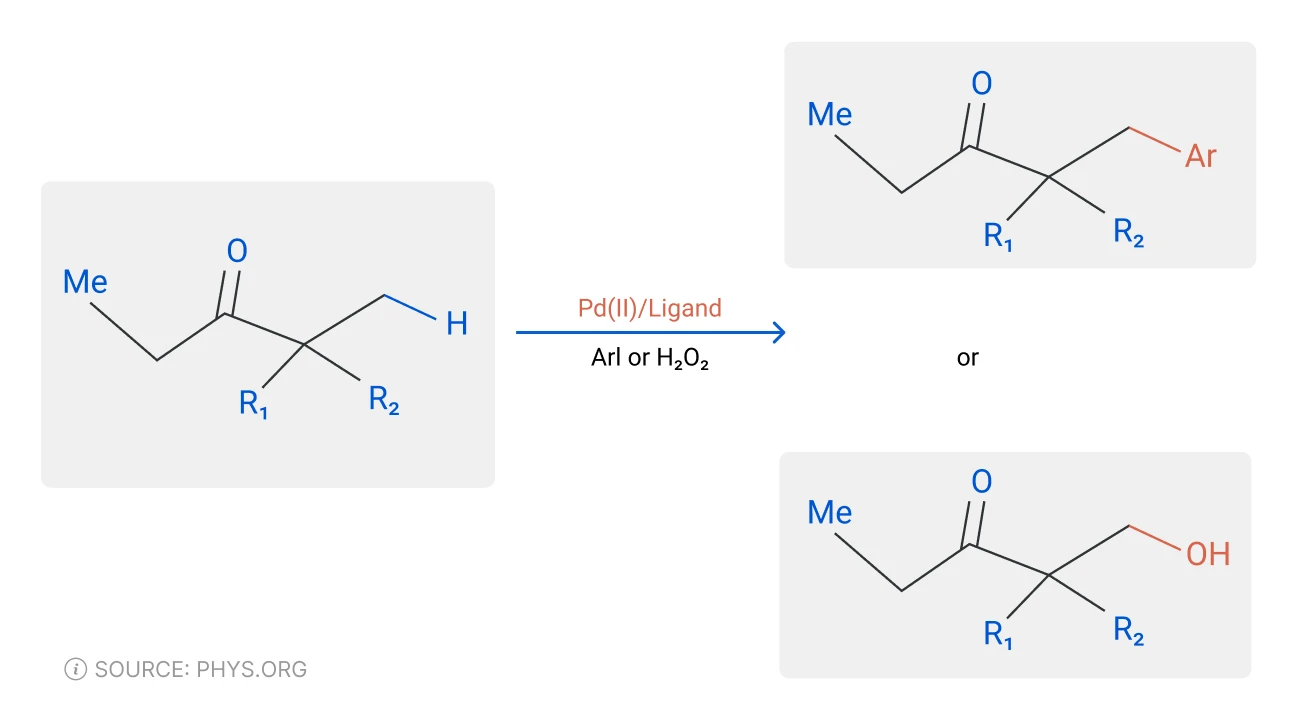
This development is of great practical importance for optimising synthetic processes in the pharmaceutical industry. The proposed method reduces dependence on traditional multi-stage production processes by minimising the number of reaction stages and byproduct formation. This improves economic efficiency and reduces the environmental impact. One possible application of this technology is reducing the production cost of common drugs such as acetylsalicylic acid (aspirin), which could transform approaches to the mass production of medicines.
This new method of carbon−hydrogen bond activation catalysed by a complex palladium compound is a significant step forward in synthetic chemistry and pharmaceuticals. It expands the possibilities for working with chemically inert compounds and makes the production of medicinal substances more efficient, sustainable and economically viable.
Source: https://phys.org/news/2025-01-chemists-potential-ketone-ester-molecules.html
Recent News

October 09 - 2025
Ivanhoe Mines, a Canadian mining and exploration company known for several high-profile discoveries, has driven underground development into the high-grade Platreef orebody for the first time. The company’s Executive Co-Chair Robert Friedland and President and Chief Executive Officer Marna Cloete detailed the breakthrough, with mining crews entering the orebody at the 850-metre level with the first blast of high-grade ore in early May.

September 24 - 2025
Canadian exploration company Power Metallic has reported results from its deepest intersection to date at the Lion Zone, carried out in the wake of successful exploration activities last year. The 2024 discovery of the zone, 5.5 kilometres away from the Nisk Main Zone, has shifted the company’s focus towards what could prove a game-changing discovery.

September 05 - 2025
Australian mining company Southern Palladium has received an environmental authorization (EA) on its flagship Tier 1 Bengwenyama project from South Africa’s Department of Mineral and Petroleum Resources (DMPR). The license outlines rights on underground mining and related infrastructural activities on the project, marking a key milestone towards development.

August 25 - 2025
A study from a team of chemists working at McGill University in Montreal, Canada has proposed a new method for synthesising palladium catalysts using electrochemical potential, supporting both oxidative addition and reductive elimination with two-electron exchange in mild temperature and pressure conditions.

August 05 - 2025
A team of functional materials researchers in China developed a copper–palladium catalyst that has been shown to improve catalytic activity and selectivity in the electrochemical nitrate reduction reaction (NO3RR), leading to improved ammonia yields. Scaling this process could significantly reduce the energy and environmental burden of the ammonia industry as a whole.

July 21 - 2025
Zhe Gong et al. from the China University of Geosciences and Zhiping Deng and Xiaolei Wang from the University of Alberta (Canada) have developed a highly efficient palladium catalyst that could support the large-scale rollout of hydrogen fuel cells. The catalyst was designed by doping palladium with cobalt producing atomic cobalt (Co)-doped Pd metallene (Co-Pdene), and demonstrated exceptional electrocatalytic performance while maintaining its structural integrity.