


New palladium catalyst points to drastic reduction in hydrogen energy costs
Published April 07 - 2025
A new palladium-containing catalyst could accelerate the large-scale rollout of green hydrogen energy.

Tokyo University of Science, Katsushika Campus. Image: Wikimedia Commons
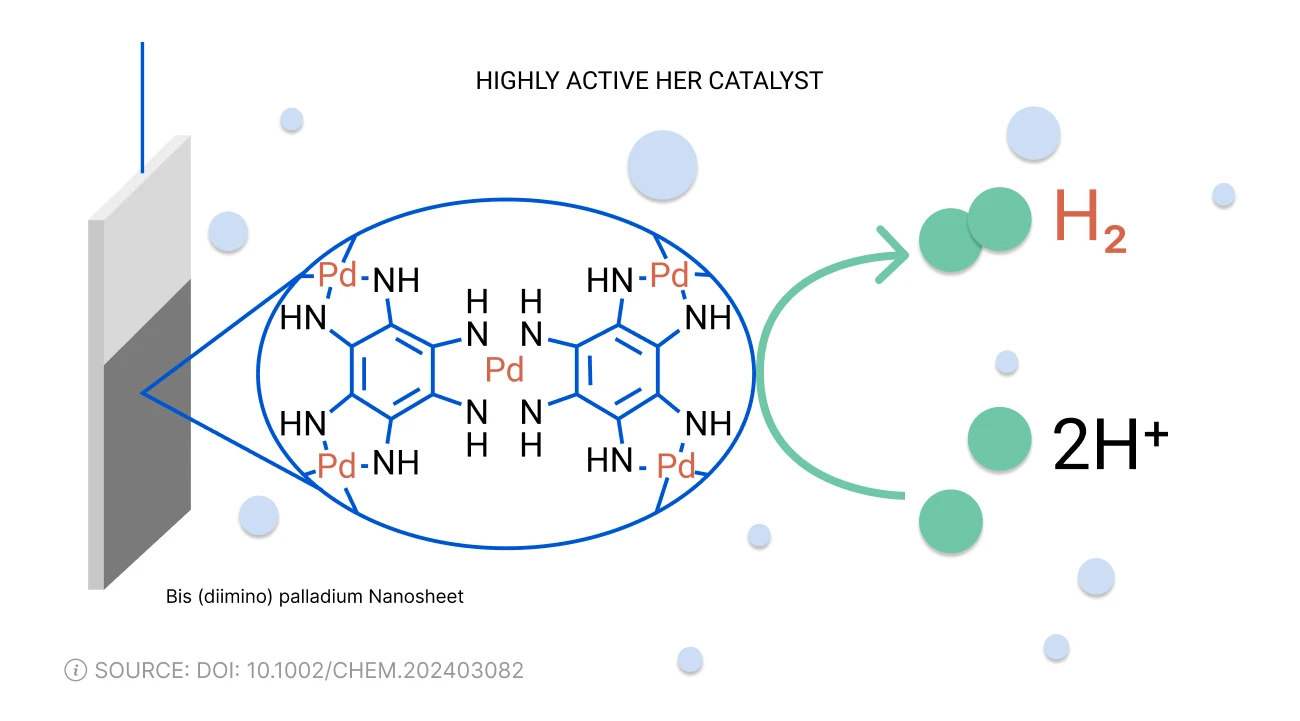
The novel two-dimension material with Pd was studied in detail in the hydrogen evolution reaction (HER) process, catalysing the electrolysis of water into oxygen and hydrogen. As part of the HER process, the hydrogen atoms generated at the electrode’s surface are converted during electrolysis into hydrogen gas, H₂. This gas can then be used in a number of industries, from clean energy and the treatment of metals to fertiliser production and food processing. Nevertheless, scarcity and high cost of catalysts significantly increase hydrogen manufacturing expenses, limiting its large-scale application.
The study published earlier this year in the Chemistry: A European Journal reports about synthesized bis(diimino)palladium coordination nanosheets (PdDI) catalyst. PdDI nanosheets have maximised catalytic activity and use only a fraction of the amount of precious metals compared with traditional platinum, and therefore present an opportunity to revolutionize the production of hydrogen.
The research was led by Professor Hiroshi Nishihara, a renowned researcher in coordination chemistry and electrochemistry, and Dr Hiroaki Maeda, both of whom from the Tokyo University of Science. The work was conducted in collaboration with researchers from a number of other institutions, including the University of Tokyo, the Japan Synchrotron Radiation Research Institute (JASRI), the Kyoto Institute of Technology, RIKEN SPring-8 Center (RSC), and the National Institute for Materials Science of Japan.
The team synthesised PdDI nanosheets using two methods: gas-liquid interfacial synthesis (C-PdDI) and electrochemical oxidation (E-PdDI). The activated E-PdDI demonstrated remarkable catalytic performance, comparable to metallic platinum. E-PdDI exhibits low overpotential of 34mV and an exchange current density of 2.1 mA/cm2 which matches platinum’s catalytic activity. Additionally, the material demonstrated its robustness after 12 hours in an acidic environment, confirming a strong likelihood of being long-term stable and therefore a viable material in the large-scale production of hydrogen as low cost alternative to platinum. According to Dr Maeda, “Our research brings us one step closer to making H₂ production more affordable and sustainable, a crucial step for achieving a clean energy future.”
With regard to hydrogen, as an emerging energy source it could play a major role in the energy transition towards clean and sustainable zero-emissions power. The latest catalytic development could help researchers overcome the prohibitive costs of existing solutions, which have slowed the scaling up of hydrogen energy. The study was selected as a cover feature for the Chemistry: A European Journal underscoring the importance of the findings.
In addition to the production of hydrogen through electrolysis, palladium also has huge prospects to play a key role in storage and transportation of H2. In a standard temperature and pressure environment, palladium can absorb as much as 900 times its own volume of hydrogen, making it an excellent carrier. In fuel cells, hydrogen is fed into an anode and oxygen-containing air is fed to the cathode, with a catalyst generating electricity. The only byproduct of this process is water.
Research into new palladium applications and technologies is underway all over the world, with significant potential in key industries such as power generation, transportation and the chemical sector. Palladium’s unique properties, such as its catalytic activity and ability to absorb large amounts of hydrogen, make it highly sought-after in green technologies. In addition to hydrogen energy, the precious metal is being studied with a view to advancing the circular economy in solar panels, water purification and microelectronics.
Source: https://chemistry-europe.onlinelibrary.wiley.com/doi/10.1002/chem.202403082
Recent News

October 09 - 2025
Ivanhoe Mines, a Canadian mining and exploration company known for several high-profile discoveries, has driven underground development into the high-grade Platreef orebody for the first time. The company’s Executive Co-Chair Robert Friedland and President and Chief Executive Officer Marna Cloete detailed the breakthrough, with mining crews entering the orebody at the 850-metre level with the first blast of high-grade ore in early May.

September 24 - 2025
Canadian exploration company Power Metallic has reported results from its deepest intersection to date at the Lion Zone, carried out in the wake of successful exploration activities last year. The 2024 discovery of the zone, 5.5 kilometres away from the Nisk Main Zone, has shifted the company’s focus towards what could prove a game-changing discovery.

September 05 - 2025
Australian mining company Southern Palladium has received an environmental authorization (EA) on its flagship Tier 1 Bengwenyama project from South Africa’s Department of Mineral and Petroleum Resources (DMPR). The license outlines rights on underground mining and related infrastructural activities on the project, marking a key milestone towards development.

August 25 - 2025
A study from a team of chemists working at McGill University in Montreal, Canada has proposed a new method for synthesising palladium catalysts using electrochemical potential, supporting both oxidative addition and reductive elimination with two-electron exchange in mild temperature and pressure conditions.

August 05 - 2025
A team of functional materials researchers in China developed a copper–palladium catalyst that has been shown to improve catalytic activity and selectivity in the electrochemical nitrate reduction reaction (NO3RR), leading to improved ammonia yields. Scaling this process could significantly reduce the energy and environmental burden of the ammonia industry as a whole.

July 21 - 2025
Zhe Gong et al. from the China University of Geosciences and Zhiping Deng and Xiaolei Wang from the University of Alberta (Canada) have developed a highly efficient palladium catalyst that could support the large-scale rollout of hydrogen fuel cells. The catalyst was designed by doping palladium with cobalt producing atomic cobalt (Co)-doped Pd metallene (Co-Pdene), and demonstrated exceptional electrocatalytic performance while maintaining its structural integrity.