


New research on palladium membrane technology clarifies hydrogen transfer pathways
Published April 13 - 2025

University of British Columbia. Image: University of British Columbia
Researchers at the University of British Columbia have conducted a new detailed study of the hydrogen transfer pathways using a palladium membrane reactor. The study looks at the differences between homolytic and heterolytic pathways during hydrogenation reactions, noting how the behaviour of hydrogen changes based on different levels of current density. In a homolytic transfer, two Pd–H bonds generate two hydrogen radicals (H•), while in a heterolytic transfer they create a proton (H+) and a hydride (H-).
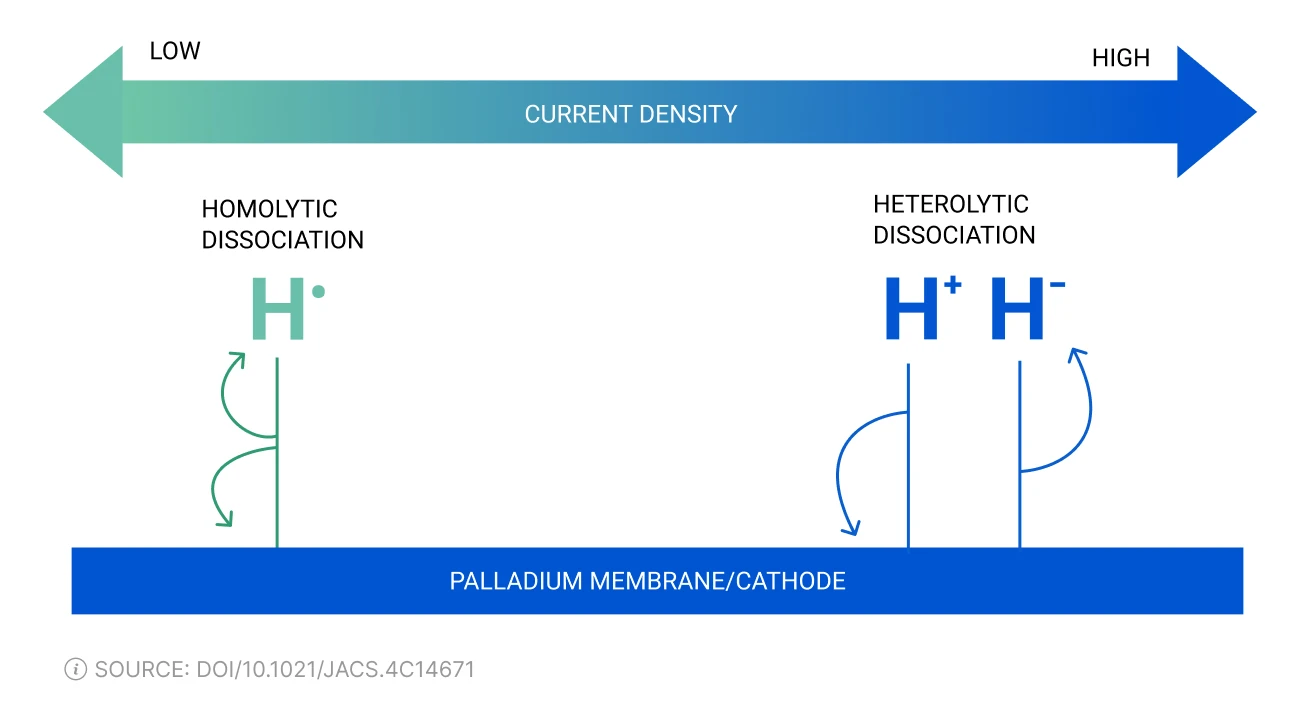
The palladium membrane reactor consists of two chambers – an electrochemical chamber and a hydrogenation chamber. This allows the equipment to separate hydrogen adsorption and hydrogenation processes, supporting distinct reaction pathways and thereby avoiding complications related to exclusive thermochemical catalysis. The palladium membrane reactor offers both thermochemical and electrochemical functionalities, with the membrane acting variously as a cathode, a hydrogen-selective membrane, and a heterogeneous hydrogenation catalyst.
With thermochemical processes, where dissociation and hydrogenation occur at the same surface, small changes in temperature or pressure can result in significant changes to the PdHx ratio. Additionally, hydrogen is most often transferred to the reactant through a homolytic mechanism, given the minimal electronegativity difference between the two atoms. Heterolytic mechanisms, on the other hand, usually require catalyst surface modification such as oxides, the isolation of single atoms or a catalyst support.
Electrochemical hydrogenation reactions support direct electron transfer from an electrode surface to a reactant in solution. This electron transfer is followed by a proton transfer or vice versa. The pathway depends on the reduction potential of the reactant, the electrode material, and the potential applied to the cathode.
The results of the research showed that palladium membrane reactors enable hydrogenation in ambient conditions, without the need for hydrogen. The protons generated by the electrolysis of water were reduced to Pd–H on one side of a palladium foil layer, and the adsorbed H atoms then migrate through the palladium from the electrolysis chamber to the hydrogenation chamber on the other side of the foil. The hydrogen reacts with unsaturated species in the hydrogenation chamber.
Palladium has unique properties that make it ideal for processes involving hydrogen. Firstly, in a standard temperature and pressure environment the platinum group metal (PGM) can absorb as much as 900 times its own volume of hydrogen. More importantly for hydrogen transfer, it is permeable only to hydrogen, allowing very pure hydrogen to be obtained in experimental conditions.
The researchers were able to electrochemically control the amount of hydrogen loaded into the palladium, achieving a well-defined and stable PdHx ratio so as to properly study the chemical hydrogenation process. As a result of the study, it was shown that hydrogen atoms, protons and hydrides all display reactivity on heterogeneous palladium surfaces, while different reaction conditions favour different outcomes.
Though the hydrogenation of unsaturated species is a common process carried out at a large scale across many industries, it is difficult to define the identity of reactive hydrogen species, and therefore scientific understanding about whether hydrogenation proceeds through a homolytic or heterolytic pathway has been lacking.
The latest study found that a low current density, i.e. a low level of electrode polarisation, favoured homolytic dissociation, whereas high currents precipitated heterolytic dissociation. With each increase of current density – 40, 80, 120, 160 and 200 mA cm-2 were all tested – the rate of H• transfer decreased and the rate of H+/H- transfer increased.
The research was carried out by Mia Stankovic, Bowen Ge, Jessica Sperryn and Curtis Berlinguette, all of whom are based at the University of British Columbia’s Department of Chemistry. The study was published by the Journal of the American Chemical Society, and received funding from a number of Canadian bodies including the Canada First Research Excellence Fund.
Recent News

October 09 - 2025
Ivanhoe Mines, a Canadian mining and exploration company known for several high-profile discoveries, has driven underground development into the high-grade Platreef orebody for the first time. The company’s Executive Co-Chair Robert Friedland and President and Chief Executive Officer Marna Cloete detailed the breakthrough, with mining crews entering the orebody at the 850-metre level with the first blast of high-grade ore in early May.

September 24 - 2025
Canadian exploration company Power Metallic has reported results from its deepest intersection to date at the Lion Zone, carried out in the wake of successful exploration activities last year. The 2024 discovery of the zone, 5.5 kilometres away from the Nisk Main Zone, has shifted the company’s focus towards what could prove a game-changing discovery.

September 05 - 2025
Australian mining company Southern Palladium has received an environmental authorization (EA) on its flagship Tier 1 Bengwenyama project from South Africa’s Department of Mineral and Petroleum Resources (DMPR). The license outlines rights on underground mining and related infrastructural activities on the project, marking a key milestone towards development.

August 25 - 2025
A study from a team of chemists working at McGill University in Montreal, Canada has proposed a new method for synthesising palladium catalysts using electrochemical potential, supporting both oxidative addition and reductive elimination with two-electron exchange in mild temperature and pressure conditions.

August 05 - 2025
A team of functional materials researchers in China developed a copper–palladium catalyst that has been shown to improve catalytic activity and selectivity in the electrochemical nitrate reduction reaction (NO3RR), leading to improved ammonia yields. Scaling this process could significantly reduce the energy and environmental burden of the ammonia industry as a whole.

July 21 - 2025
Zhe Gong et al. from the China University of Geosciences and Zhiping Deng and Xiaolei Wang from the University of Alberta (Canada) have developed a highly efficient palladium catalyst that could support the large-scale rollout of hydrogen fuel cells. The catalyst was designed by doping palladium with cobalt producing atomic cobalt (Co)-doped Pd metallene (Co-Pdene), and demonstrated exceptional electrocatalytic performance while maintaining its structural integrity.