


Organic catalyst discovery points to enhanced palladium applications in green chemistry
Published February 26 - 2025
A team of researchers at King Khalid University in Abha, Saudi Arabia has developed a promising new heterogeneous catalyst containing palladium nanoparticles. The catalyst material, known as KIT-6@L-H-Pd, has shown very high levels of efficiency and selectivity. The key functionality identified at the current stage is in two significant processes for organic chemistry: the oxidation of sulphides to sulphoxides and the amination of aryl halides.

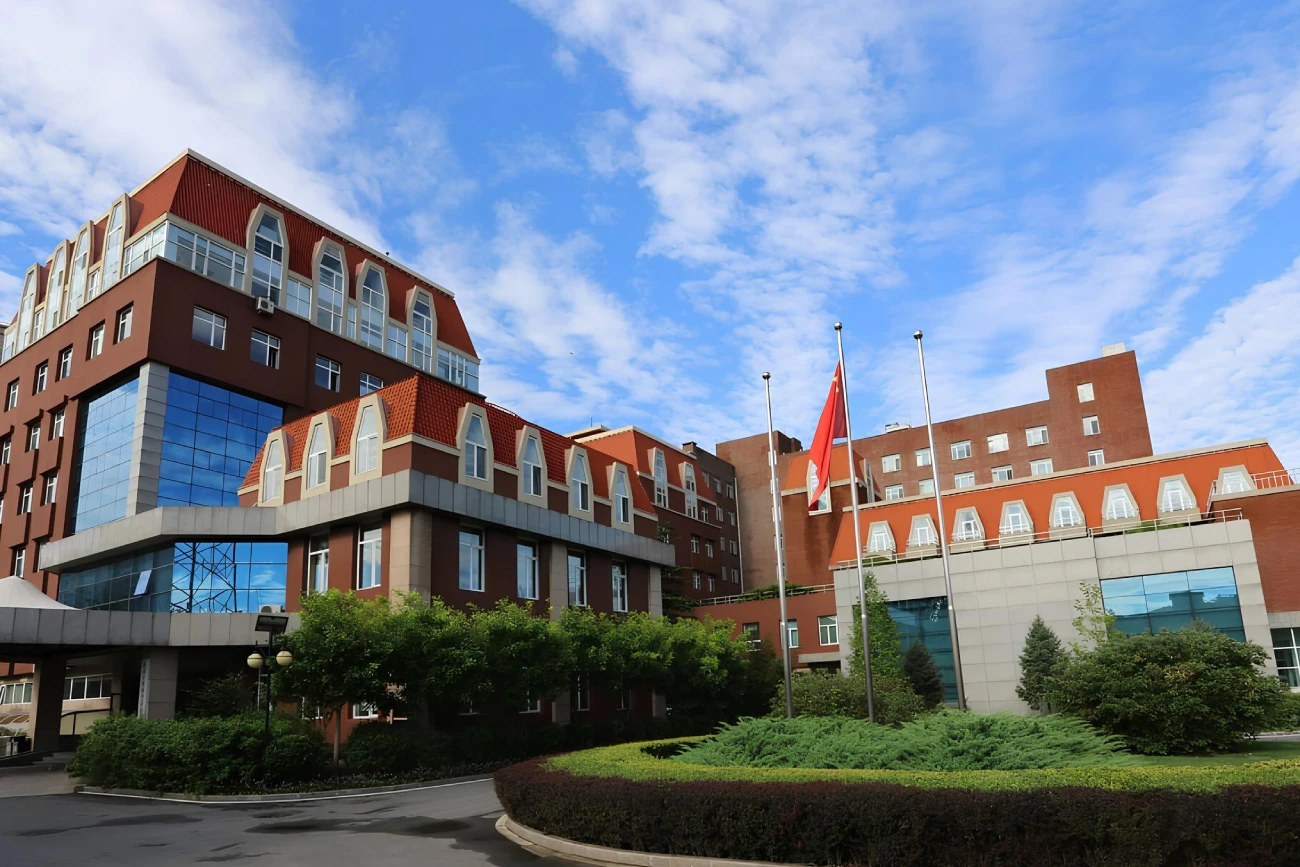
King Khalid University. Image: King Khalid University (https://www.kku.edu.sa/en/news/102312)
The team observed the behaviour of the catalyst using a number of techniques, including thermogravimetric analysis, Fourier transform infrared spectroscopy (FTIR), small angle x-ray diffraction and scanning electron microscopy (SEM) with energy dispersive X-ray microanalysis. These methods allowed scientists to establish that the palladium nanoparticles had been successfully incorporated into the internal structures of KIT-6@L-H.
The initial conclusions have shown that the new material has a high catalytic performance, is relatively low in cost and is easy to synthesis using nanostructured mesoporous silica KIT-6, L-histidine and palladium (II) acetate Pd(OAc)2. In traditional homogeneous structures, the catalyst is often unrecoverable after the reaction, whereas KIT-6@L-H-Pd can be simply recovered and reused multiple times without losing significant amounts of palladium, which is hugely promising in terms of service life and cost at scale.
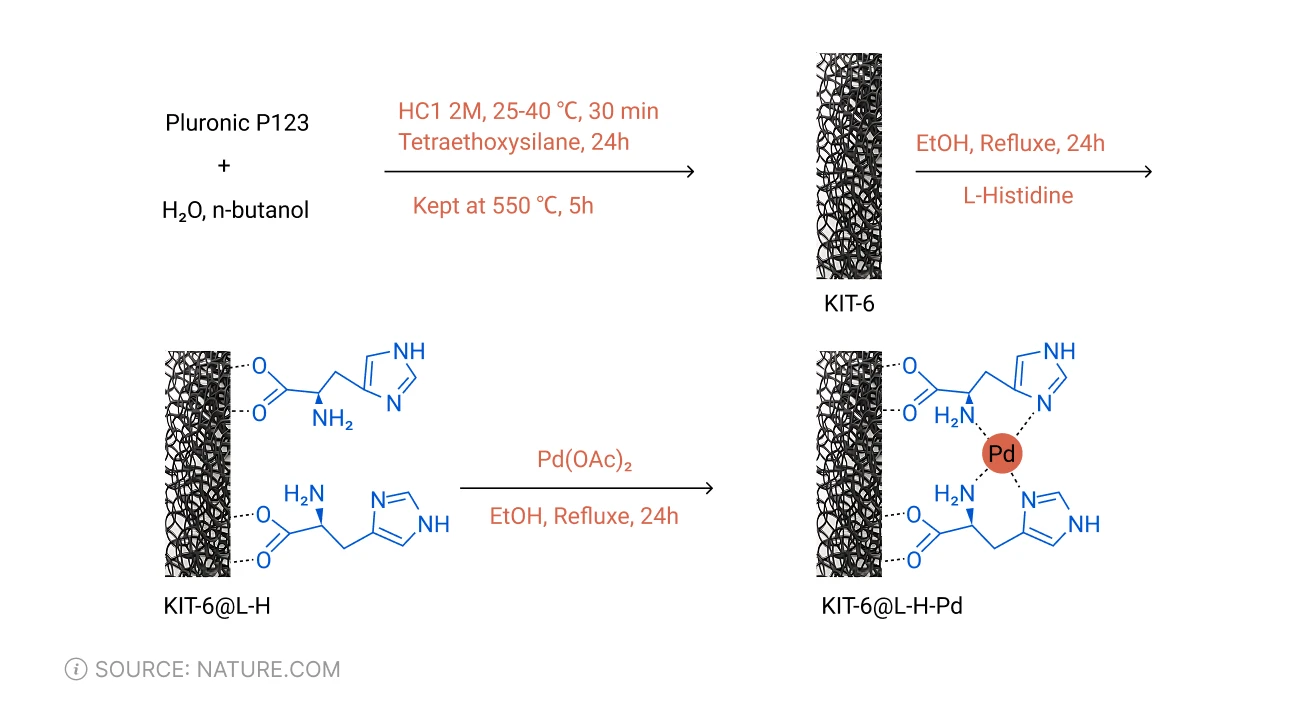
The reaction conditions were optimised and the catalyst achieved high yields of sulphoxides and amines, reaching completion rapidly and showing high levels of chemoselectivity for a number of different substrates. Additionally, the reactions with yield up to 98% took place in solve-free conditions. One of the most promising results was the average isolated yield 96% achieved over five reaction and recovery cycles in the oxidation of methylphenyl sulfide while showing no marked degradation in the catalyst’s performance.
High stability makes the catalyst a possible game-changer in the pharmaceuticals industry, as well as other sectors that rely on organic synthesis. The reactions carried out using KIT-6@L-H-Pd are vital processes in the synthesis of pharmaceuticals and organic compounds –sulphoxides and arylamines are particularly important materials in medicinal chemistry and a number of industrial applications. The new catalyst therefore has the potential to ‘green’ an industry that previously relied on methods involving hazardous reagents, while also bringing down costs significantly.
The use of palladium nanoparticles is still in its infancy, and there is a broad scope for further exploration of potential applications for this new compound. Nevertheless, the high catalytic activity, low cost and environmentally friendly materials are all encouraging signs. The researchers are continuing their investigations into novel heterogeneous catalysts using the KIT-6 model as their basis, paving the way to a greener future for the chemicals industry.
Source: https://www.nature.com/articles/s41598-025-86579-7, https://evrimagaci.org/tpg/new-palladium-catalyst-surges-ahead-for-green-chemistry-innovations-159822
Recent News

October 09 - 2025
Ivanhoe Mines, a Canadian mining and exploration company known for several high-profile discoveries, has driven underground development into the high-grade Platreef orebody for the first time. The company’s Executive Co-Chair Robert Friedland and President and Chief Executive Officer Marna Cloete detailed the breakthrough, with mining crews entering the orebody at the 850-metre level with the first blast of high-grade ore in early May.

September 24 - 2025
Canadian exploration company Power Metallic has reported results from its deepest intersection to date at the Lion Zone, carried out in the wake of successful exploration activities last year. The 2024 discovery of the zone, 5.5 kilometres away from the Nisk Main Zone, has shifted the company’s focus towards what could prove a game-changing discovery.

September 05 - 2025
Australian mining company Southern Palladium has received an environmental authorization (EA) on its flagship Tier 1 Bengwenyama project from South Africa’s Department of Mineral and Petroleum Resources (DMPR). The license outlines rights on underground mining and related infrastructural activities on the project, marking a key milestone towards development.

August 25 - 2025
A study from a team of chemists working at McGill University in Montreal, Canada has proposed a new method for synthesising palladium catalysts using electrochemical potential, supporting both oxidative addition and reductive elimination with two-electron exchange in mild temperature and pressure conditions.
August 05 - 2025
A team of functional materials researchers in China developed a copper–palladium catalyst that has been shown to improve catalytic activity and selectivity in the electrochemical nitrate reduction reaction (NO3RR), leading to improved ammonia yields. Scaling this process could significantly reduce the energy and environmental burden of the ammonia industry as a whole.
July 21 - 2025
Zhe Gong et al. from the China University of Geosciences and Zhiping Deng and Xiaolei Wang from the University of Alberta (Canada) have developed a highly efficient palladium catalyst that could support the large-scale rollout of hydrogen fuel cells. The catalyst was designed by doping palladium with cobalt producing atomic cobalt (Co)-doped Pd metallene (Co-Pdene), and demonstrated exceptional electrocatalytic performance while maintaining its structural integrity.