


Palladium metallene shows promise in boosting fuel cell catalyst efficiency
Published July 21 - 2025

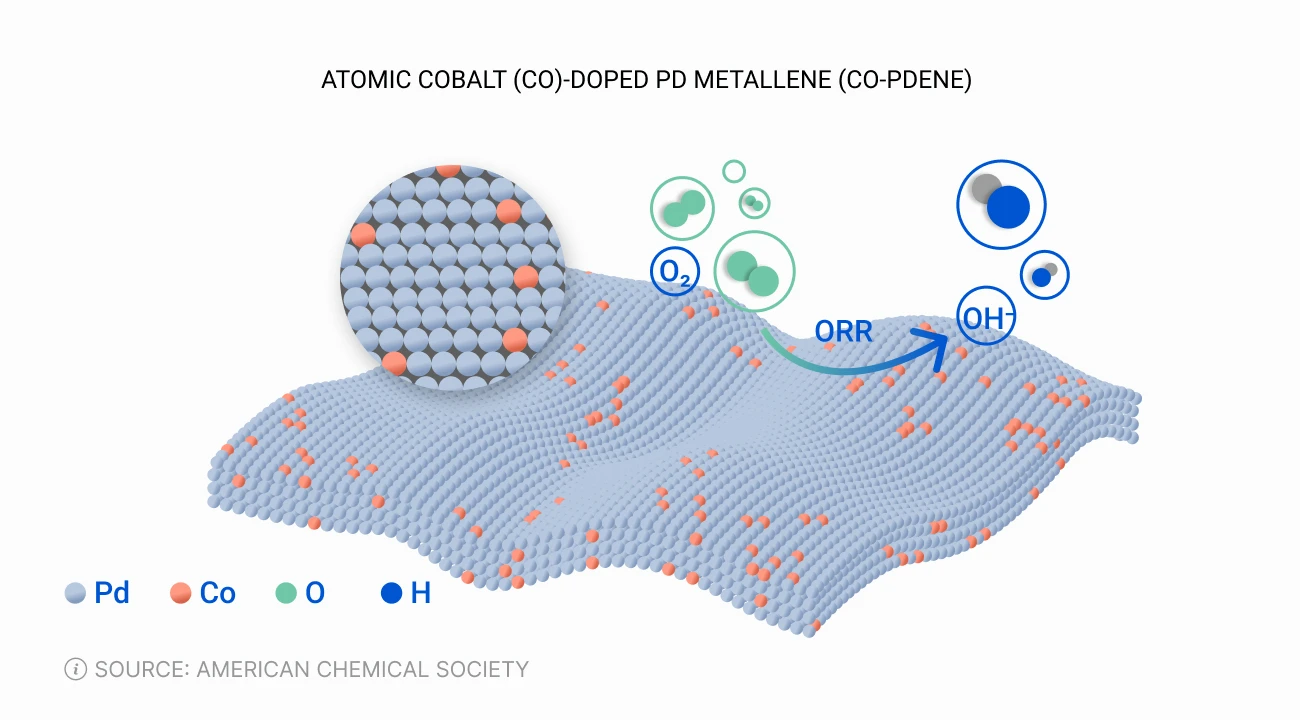
Zhe Gong et al. from the China University of Geosciences and Zhiping Deng and Xiaolei Wang from the University of Alberta (Canada) have developed a highly efficient palladium catalyst that could support the large-scale rollout of hydrogen fuel cells. The catalyst was designed by doping palladium with cobalt producing atomic cobalt (Co)-doped Pd metallene (Co-Pdene), and demonstrated exceptional electrocatalytic performance while maintaining its structural integrity.
Hydrogen fuel cells are emerging as a highly efficient and portable source of energy, with water as the only byproduct. They are not, however, an energy source in their own right, as the hydrogen they store is produced via electrolysis. There are a number of popular methods for generating hydrogen for fuel cells, including alkaline water electrolysis, solid oxide electrolysis and proton exchange membrane (PEM) electrolysis. The latter is favoured as it is efficient, high-speed and operates at low temperatures, while producing very pure hydrogen.
The performance of PEM fuel cells is determined by the efficiency and durability of the cathode electrocatalysts, which can encounter difficulties during the oxygen reduction reaction (ORR). This reaction occurs at the cathode in the fuel cell, whereby the hydrogen combines with oxygen to generate water and producing electricity, and is known to have sluggish kinetics and high overpotential.
While palladium-based nanomaterials are considered the benchmark for ORR electrocatalysts, they are prone to contamination during the process and can suffer from instability. Palladium has stronger oxygen-binding activity compared with other platinum group metals (PGMs) such as platinum, necessitating efforts to modulate oxygen binding strength. Nanostructural design has emerged as an important technology, whereby ultrathin nanosheets or graphene-like structures are used to increase the density of active sites.
In the present study, a few atomic layers of palladium metallene – which has high palladium utilisation efficiency – were doped with cobalt. The structure has an ultrathin and highly curved morphology, and was developed using a wet-chemical approach. It achieved an electrochemical mass activity (MA) of 3.14 A per milligram palladium at 0.85 V in alkaline electrolyte. The structural integrity of the catalyst was maintained over 30,000 potential cycles, with only a 20 mV negative shift in the half-wave potential (E₁/₂), indicating strong long-term electrocatalytic stability.
The performance of the Co-Pdene catalyst points to the viability of fuel cells as a method of energy storage and release. The researchers carried out density function theory (DFT) calculations to provide a theoretical backing for the ORR activity enhancement and Co-Pdene electronic structure adjustment. These calculations revealed promising overpotential supporting a general design principle and scalable synthesis protocol for transition metal-doped Pd metallene.
Hydrogen fuel cells stand to play a critical role in the energy transition. They have potentially large-scale applications in transportation for light vehicles as well as trucks, trains, ships and even aeroplanes, with aerospace research also underway. They have significant potential in backup power and grid storage, storing surplus renewable electricity as hydrogen and reconverting it during peak demand. This would help to ensure backup capacity and balance loads in energy systems that rely heavily on renewable generation. With zero emissions at the point of use, quick refuelling times, durability and high density, hydrogen energy represents a key area of application for palladium and a potential solution for a resilient and sustainable green energy economy.
Recent News

October 09 - 2025
Ivanhoe Mines, a Canadian mining and exploration company known for several high-profile discoveries, has driven underground development into the high-grade Platreef orebody for the first time. The company’s Executive Co-Chair Robert Friedland and President and Chief Executive Officer Marna Cloete detailed the breakthrough, with mining crews entering the orebody at the 850-metre level with the first blast of high-grade ore in early May.

September 24 - 2025
Canadian exploration company Power Metallic has reported results from its deepest intersection to date at the Lion Zone, carried out in the wake of successful exploration activities last year. The 2024 discovery of the zone, 5.5 kilometres away from the Nisk Main Zone, has shifted the company’s focus towards what could prove a game-changing discovery.

September 05 - 2025
Australian mining company Southern Palladium has received an environmental authorization (EA) on its flagship Tier 1 Bengwenyama project from South Africa’s Department of Mineral and Petroleum Resources (DMPR). The license outlines rights on underground mining and related infrastructural activities on the project, marking a key milestone towards development.

August 25 - 2025
A study from a team of chemists working at McGill University in Montreal, Canada has proposed a new method for synthesising palladium catalysts using electrochemical potential, supporting both oxidative addition and reductive elimination with two-electron exchange in mild temperature and pressure conditions.

August 05 - 2025
A team of functional materials researchers in China developed a copper–palladium catalyst that has been shown to improve catalytic activity and selectivity in the electrochemical nitrate reduction reaction (NO3RR), leading to improved ammonia yields. Scaling this process could significantly reduce the energy and environmental burden of the ammonia industry as a whole.

July 11 - 2025
A team of researchers at the University of Milan has developed a new method to speed up the hydrogenation and dehydrogenation of magnesium nanoparticles that could significantly improve the efficiency of hydrogen storage and support easier scaling up the technology.