


Home NewsPalladium nanoneedle structures enhance hydrogen transfer efficiency in magnesium-based storage systems
NewsPalladium nanoneedle structures enhance hydrogen transfer efficiency in magnesium-based storage systems Palladium nanoneedle structures enhance hydrogen transfer efficiency in magnesium-based storage systems
Published July 11 - 2025
A team of researchers at the University of Milan has developed a new method to speed up the hydrogenation and dehydrogenation of magnesium nanoparticles that could significantly improve the efficiency of hydrogen storage and support easier scaling up the technology.

University of Milan. Image: Wikimedia Commons (Saliko)
Magnesium is a promising material for storing hydrogen thanks to its low weight, high natural abundance, non-toxicity and ability to adsorb high hydrogen content – up to 7.6 wt % forming magnesium hydride. While MgH2 stability is good for storage, hydrogen release is endothermic process at almost 283 °C at 1 bar of pressure. This is an obstacle to scaling up magnesium-based storage.
The researchers investigated the potential for lower hydrogen desorption temperatures when using nanostructured magnesium, with promising early results. Nanostructured materials are those for which a single unit, which could be a cluster, crystal or molecule, measures between 1 and 100 nanometres. The weaker hydrogen bonding within the magnesium lattice allows for a lower desorption temperature.
Hydrogenation of Mg is normally a slow process that could be improved by structuring magnesium as nanoparticles. Nanoparticles increase active surface area, but at the same time increase the risk of oxidizing in the open air creating a layer of MgO, which affects the hydrogenation process. To eliminate oxidizing nanoparticles layer was covered by protective film of SiNx. But protective layer also prevents direct hydrogenation, so another way has to be created или it is necessary to create another way for hydrogen to easily reach the magnesium.
Palladium has excellent oxidizing stability as well as the ability to catalytically dissociate H2 molecules into H atoms and support their rapid diffusion into its lattice. In this work, a palladium layer was used to transfer hydrogen towards the magnesium nanoparticles sandwiched between palladium bottom layer and silicon nitride cover. Using this approach, a thicker magnesium nanoparticle layer leads to slower hydrogenation of the uppermost nanoparticle layers in the layer. The new idea proposed by researcher’s team to solve this problem is use so-called palladium nanoneedles which can function, in the authors’ terminology, as “highways”, supporting the faster diffusion of hydrogen atoms to the magnesium nanoparticles further from the plane of intersection between the palladium and magnesium layers.
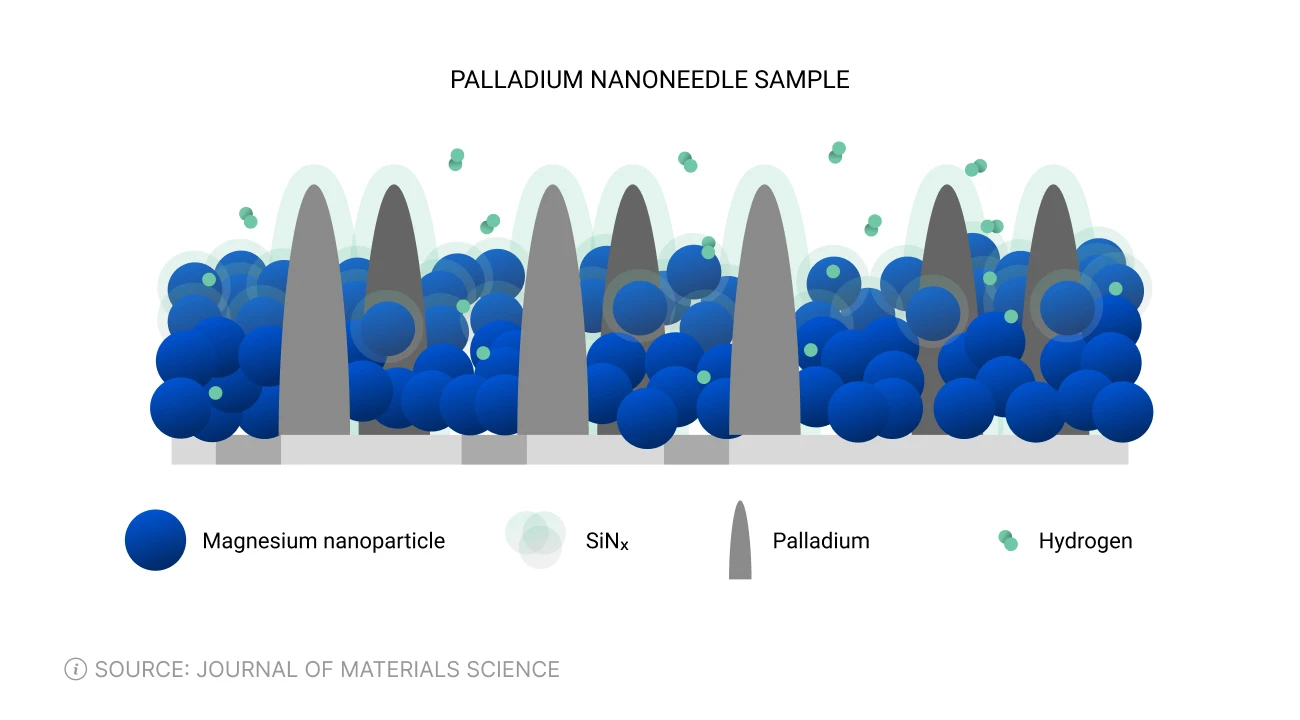
The new nanoneedle structure represents a simple and affordable method for hydrogenation and dehydrogenation of magnesium nanoparticles, offering greater coverage and speed compared with a flat palladium layer. This represents a possible solution to a pre-existing bottleneck in magnesium-based hydrogen storage systems. The study is currently at the proof-of-concept stage, and there is therefore vast potential for performance improvements based on changes to experiment design and configurations, as well as the introduction of other materials.
Hydrogen energy is a relatively new field in renewable energy, with significant potential to provide emissions-free power for heavy vehicles such as trucks, ships and even aeroplanes. Hydrogen fuel cells also have the potential to revolutionise energy storage, reducing dependency on electrical grids, supporting load balancing, and storing excess electricity generated through other renewable technologies such as solar and wind. Palladium is a crucial metal in green hydrogen power generation thanks to its catalytic properties, high selectivity and hydrogen absorption.
The report, authored by Katrina E. Schieck, Luca Pedicone, Stefnia Crespi and Marcel Di Vece, was published in the March 2025 edition of the Journal of Materials Science.
Source: researchgate.net
Recent News

October 09 - 2025
Ivanhoe Mines, a Canadian mining and exploration company known for several high-profile discoveries, has driven underground development into the high-grade Platreef orebody for the first time. The company’s Executive Co-Chair Robert Friedland and President and Chief Executive Officer Marna Cloete detailed the breakthrough, with mining crews entering the orebody at the 850-metre level with the first blast of high-grade ore in early May.

September 24 - 2025
Canadian exploration company Power Metallic has reported results from its deepest intersection to date at the Lion Zone, carried out in the wake of successful exploration activities last year. The 2024 discovery of the zone, 5.5 kilometres away from the Nisk Main Zone, has shifted the company’s focus towards what could prove a game-changing discovery.

September 05 - 2025
Australian mining company Southern Palladium has received an environmental authorization (EA) on its flagship Tier 1 Bengwenyama project from South Africa’s Department of Mineral and Petroleum Resources (DMPR). The license outlines rights on underground mining and related infrastructural activities on the project, marking a key milestone towards development.

August 25 - 2025
A study from a team of chemists working at McGill University in Montreal, Canada has proposed a new method for synthesising palladium catalysts using electrochemical potential, supporting both oxidative addition and reductive elimination with two-electron exchange in mild temperature and pressure conditions.

August 05 - 2025
A team of functional materials researchers in China developed a copper–palladium catalyst that has been shown to improve catalytic activity and selectivity in the electrochemical nitrate reduction reaction (NO3RR), leading to improved ammonia yields. Scaling this process could significantly reduce the energy and environmental burden of the ammonia industry as a whole.

July 21 - 2025
Zhe Gong et al. from the China University of Geosciences and Zhiping Deng and Xiaolei Wang from the University of Alberta (Canada) have developed a highly efficient palladium catalyst that could support the large-scale rollout of hydrogen fuel cells. The catalyst was designed by doping palladium with cobalt producing atomic cobalt (Co)-doped Pd metallene (Co-Pdene), and demonstrated exceptional electrocatalytic performance while maintaining its structural integrity.