


Home NewsPalladium proves instrumental in synthesising new benzimidazole compounds for cancer treatments
NewsPalladium proves instrumental in synthesising new benzimidazole compounds for cancer treatments Palladium proves instrumental in synthesising new benzimidazole compounds for cancer treatments
Published June 03 - 2025
Benzimidazole is an organic compound consisting of two fused rings – one benzene and one imidazole. This structure makes it a versatile compound with applications in various fields, including medicine, agriculture and industry.

Benzimidazole molecular conceptual model
Its most notable application is in medicine, where it can treat a wide range of diseases, including inflammatory processes, and certain types of cancer.
In medicine, benzimidazole and its derivatives are used to create drugs that combat infections caused by parasites, fungi and bacteria. Well-known examples include albendazole and mebendazole, which are derivatives of the benzimidazole molecule and are used to treat helminthiasis.
Benzimidazole’s unique ability to easily react with other substances allows new compounds with improved properties to be created. For instance, introducing different functional groups into its structure can boost its antimicrobial, antiviral or antitumour properties.
The most important step in synthesising new benzimidazole derivatives is forming a carbon–carbon bond. This bond plays a key role in creating complex molecular structures that may exhibit enhanced therapeutic properties.
Modern synthesis methods that use palladium-based catalysts allow such bonds to be formed efficiently. This increases the yield of the target product and ensures high selectivity, which is particularly important in creating new drug molecules.
Recent research in medical chemistry indicates a growing interest in benzimidazole derivatives with high biological activity. In this context, a group of scientists synthesised a new series of compounds, which are shown in the figure below and are reported on in the article Sundharaj, V. & Sarveswari, S. Microwave assisted palladium catalyzed carbon-carbon bond formation to synthesise novel benzimidazole derivatives and their Photophysical properties, molecular docking, and DFT study. Heliyon, Volume 11, Issue 3, e42105 DOI.

The synthesis process begins with the cyclisation of the benzimidazole skeleton, whereby 4-bromobenzene-1,2-diamine (1) and (tert-butoxycarbonyl)proline (2) undergo a reaction. The linking agent HATU is then used in combination with the base DIPEA to facilitate the formation of the structural fragment tert-butyl 2-(5-bromo-1H-benzo[d]imidazol-2-yl)pyrrolidine-1-carboxylate (3). The resulting intermediate product is then subjected to a Suzuki reaction with 3- and 4-aminophenylboronic acid (4), in the presence of a palladium catalyst. This leads to the formation of the intermediate product tert-butyl 2-(5-(4-aminophenyl)-1H-benzo[d]imidazol-2-yl)pyrrolidine-1-carboxylate (5).
Next, the amino group of compound 5 reacts with 2-(4-bromophenyl)acetic acid in the presence of HATU and the base DIPEA to form tert-butyl 2-(5-(4-(2-(4-bromophenyl)acetamido)phenyl)-1H-benzo[d]imidazol-2-yl)-pyrrolidine-1-carboxylate (7). The final step is another Suzuki reaction, in which various substituted boronic acids react with a palladium catalyst and potassium carbonate. This results in the formation of the target compounds with a yield of 50–80%.
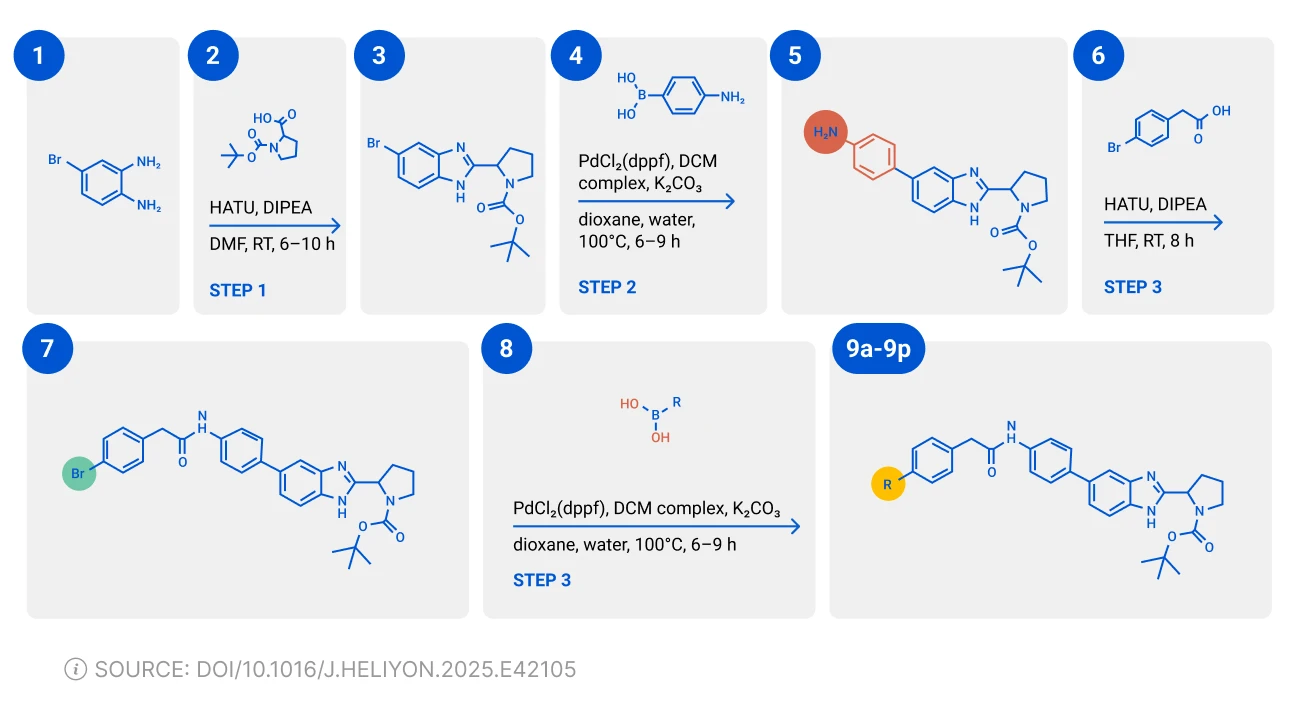
A comparative analysis of catalyst efficiency revealed that, unlike with its chloride forms, the use of pure palladium increases the yield of the target product to 80%. Pharmacological studies of the newly synthesised (9a-9p) compounds confirmed their potential as candidates for developing new anticancer drugs. Further in-depth biological tests are planned to evaluate their cytotoxic effect on tumour cells.
Recent News

October 09 - 2025
Ivanhoe Mines, a Canadian mining and exploration company known for several high-profile discoveries, has driven underground development into the high-grade Platreef orebody for the first time. The company’s Executive Co-Chair Robert Friedland and President and Chief Executive Officer Marna Cloete detailed the breakthrough, with mining crews entering the orebody at the 850-metre level with the first blast of high-grade ore in early May.

September 24 - 2025
Canadian exploration company Power Metallic has reported results from its deepest intersection to date at the Lion Zone, carried out in the wake of successful exploration activities last year. The 2024 discovery of the zone, 5.5 kilometres away from the Nisk Main Zone, has shifted the company’s focus towards what could prove a game-changing discovery.

September 05 - 2025
Australian mining company Southern Palladium has received an environmental authorization (EA) on its flagship Tier 1 Bengwenyama project from South Africa’s Department of Mineral and Petroleum Resources (DMPR). The license outlines rights on underground mining and related infrastructural activities on the project, marking a key milestone towards development.

August 25 - 2025
A study from a team of chemists working at McGill University in Montreal, Canada has proposed a new method for synthesising palladium catalysts using electrochemical potential, supporting both oxidative addition and reductive elimination with two-electron exchange in mild temperature and pressure conditions.

August 05 - 2025
A team of functional materials researchers in China developed a copper–palladium catalyst that has been shown to improve catalytic activity and selectivity in the electrochemical nitrate reduction reaction (NO3RR), leading to improved ammonia yields. Scaling this process could significantly reduce the energy and environmental burden of the ammonia industry as a whole.

July 21 - 2025
Zhe Gong et al. from the China University of Geosciences and Zhiping Deng and Xiaolei Wang from the University of Alberta (Canada) have developed a highly efficient palladium catalyst that could support the large-scale rollout of hydrogen fuel cells. The catalyst was designed by doping palladium with cobalt producing atomic cobalt (Co)-doped Pd metallene (Co-Pdene), and demonstrated exceptional electrocatalytic performance while maintaining its structural integrity.