


Car catalysts
Current technology
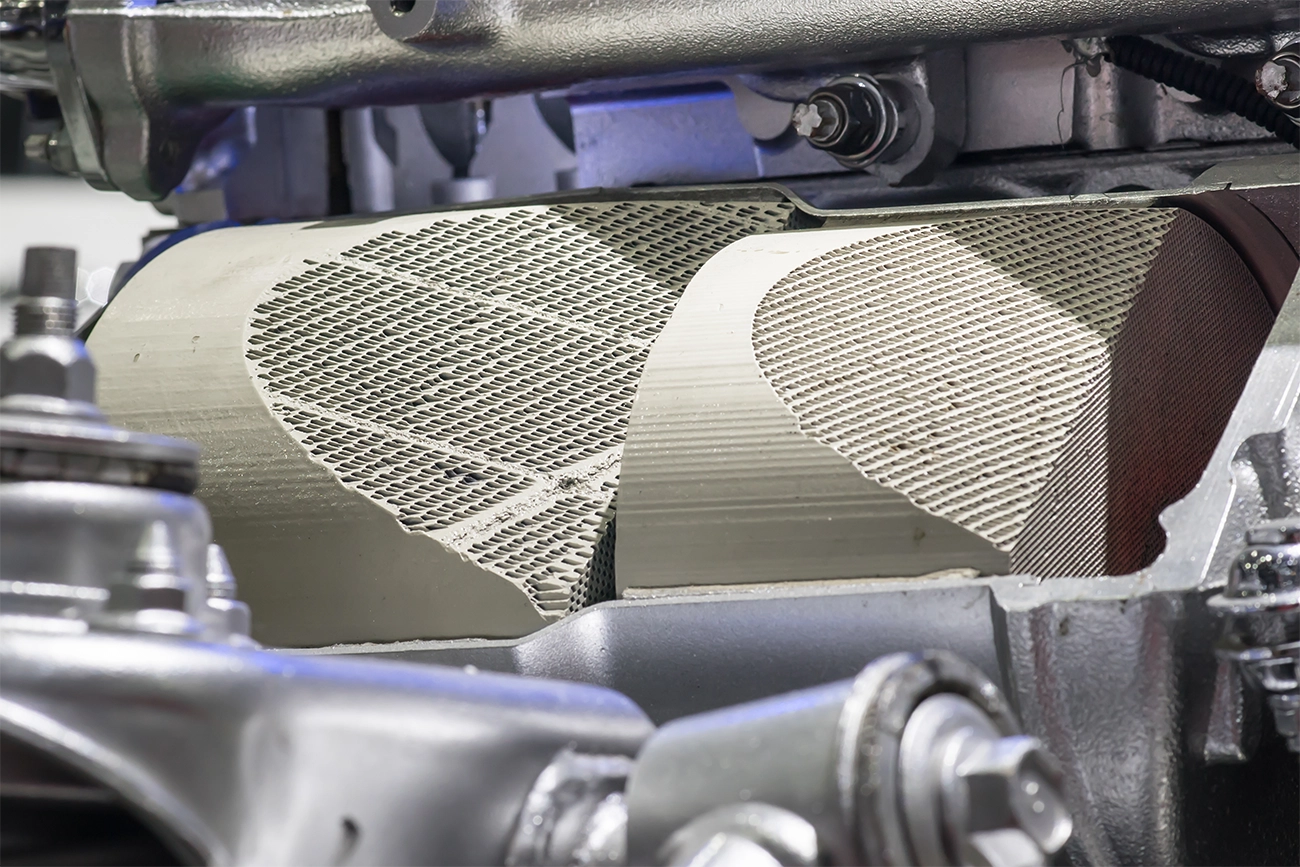
Catalytic converters are devices used to clean exhaust gases from vehicles with internal combustion engines. They are located in the exhaust system and convert harmful substances into less harmful ones during operation. These chemical reactions transform harmful substances such as forms of nitrogen oxide (NOx), carbon monoxide (CO) and unburned hydrocarbons into safer substances. The catalytic metals palladium, platinum and rhodium in the converter initiate these reactions.
The process begins when the temperature exceeds 300 °C and continues until the optimal operating temperature of 400–800 °C is reached. During this time, the catalytic metals oxidise unburned hydrocarbons, turning them into water vapour and carbon dioxide. They also oxidise carbon and turn carbon monoxide into carbon dioxide.
It is important to note that the catalytic converter does not start working immediately after the engine is started. It takes time for the exhaust gases to reach the optimal temperature for the chemical reactions to occur.
Because of the need for high temperatures in order to facilitate chemical reactions, engineers place catalytic converters near the exhaust manifolds of cars, where the hot combustion products from the engine are directed. Inside the converters, these gases are cooled, slowed down and cleaned of harmful pollutants.
Market
The trend towards global is reducing demand for mobility solutions with internal combustion engines. By 2040, their share is expected to decrease from the current level of 70% to 30–40%, according to a BloombergNEF report among others. This shift is driven by increasing regulatory pressures, technological advancements in electric vehicles, and growing consumer awareness about environmental issues.
Challenges of current technology
Modern automotive catalytic converters are complex three-component devices. The core of the converter consists of ceramic or metal honeycombs, and sometimes ceramic beads. Depending on the model, a micro-layer of palladium, platinum or rhodium particles is applied to the honeycomb walls.
The first stage of the automotive exhaust gas converter is the oxidation stage, also known as the oxidation catalyst, which is designed to reduce the levels of carbon monoxide (CO) and hydrocarbons. It operates through catalytic reactions involving metals like palladium and platinum.
The second stage involves the reduction part of the exhaust gas converter, also known as the reduction catalyst, which is intended to reduce the levels of nitrogen oxides (NOx). Palladium and rhodium are also used as catalytic metals in this part of the converter.
The third element is the oxygen sensor, which analyses the exhaust gas composition as it exits the catalyst and sends the data to the vehicle’s onboard computer. For diesel engine vehicles, a particulate filter is always installed alongside the catalyst.
The key challenges involved in catalytic converters include the high cost of the precious metals used, such as rhodium and iridium, which are more expensive than palladium and platinum. These metals are crucial for the efficient operation of catalytic converters, but their high prices affect the overall cost of the vehicle.
Positive impact of palladium
Palladium exhibits excellent catalytic activity at lower temperatures, which increases fuel efficiency and reduces emissions of harmful substances into the atmosphere in cars.
In addition, its ability to withstand high operating temperatures without significant deterioration in quality makes it highly reliable during prolonged use.
Thanks to these advantages, palladium is currently a primary component in automotive catalysts.
To find out more about the catalytic qualities of palladium see – Chemistry.
To find out more about palladium in automotive catalytic converters, see the following scientific publications:
- Aluha, J. L., Pattrick, G., & van der Lingen, E. (2009). Palladium-based catalysts with improved sulphur tolerance for diesel-engine exhaust systems. Topics in Catalysis, 52, 1977-1982. DOI: https://doi.org/10.1007/s11244-009-9373-3
- Soni, K. C., Krishna, R., Chandra Shekar, S., & Singh, B. (2016). Catalytic oxidation of carbon monoxide over supported palladium nanoparticles. Applied Nanoscience, 6, 7-17. DOI: https://doi.org/10.1007/s13204-015-0419-5
- Hihara, T., Nagata, M., Fujita, T., & Abe, H. (2024). Site-targeted decoration of palladium nanocrystals for catalytic CH 4 removal in lean-burn exhaust. RSC advances, 14(24), 17213-17217. DOI: https://doi.org/10.1039/D4RA02237H
- Klingstedt, F., Neyestanaki, A. K., Byggningsbacka, R., Lindfors, L. E., Lundén, M., Petersson, M., … & Väyrynen, J. (2001). Palladium based catalysts for exhaust aftertreatment of natural gas powered vehicles and biofuel combustion. Applied Catalysis A: General, 209(1-2), 301-316. DOI: https://doi.org/10.1016/S0926-860X(00)00768-7