


Connections in microelectronics
Current technology
Connections in microelectronics are divided into the following main groups:
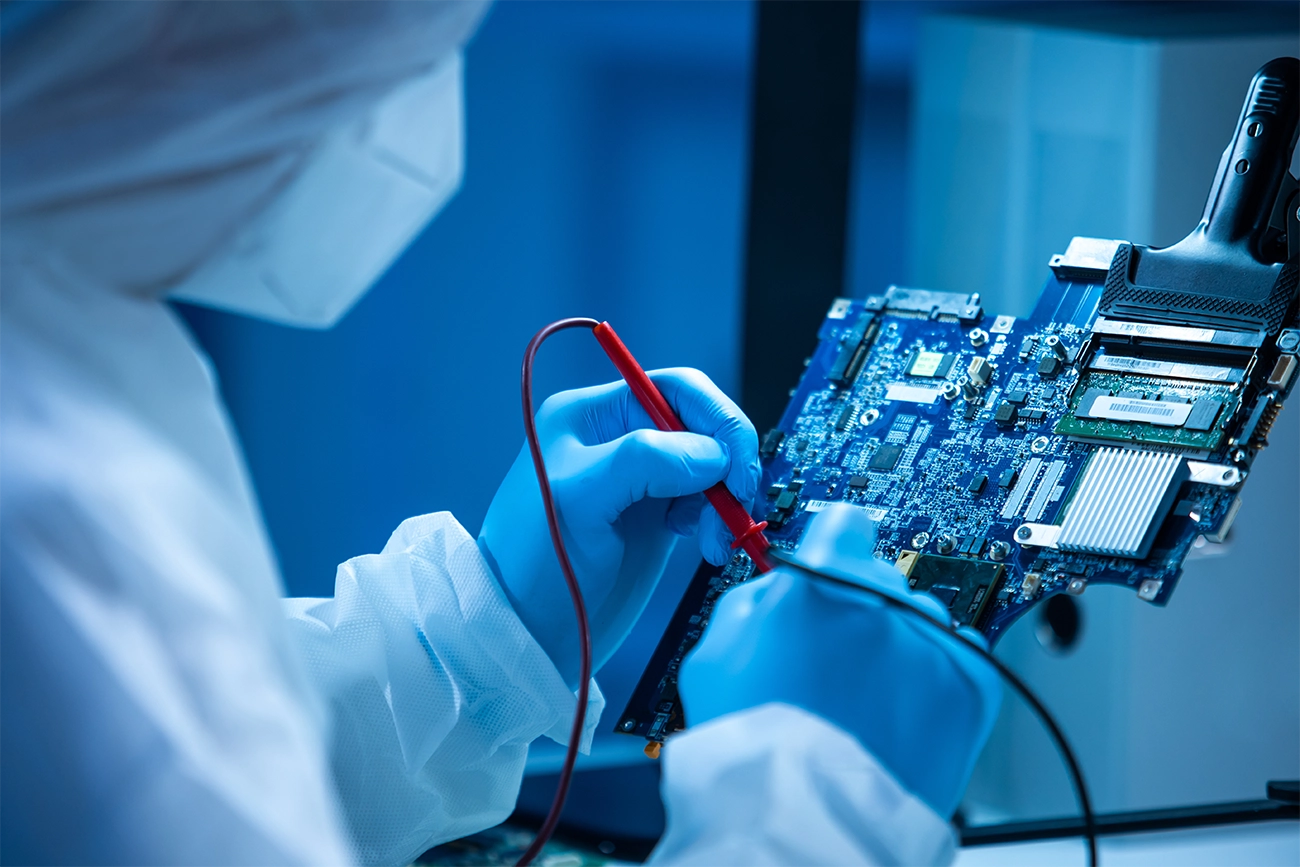
- Printed circuit boards (PCB): These are the primary platforms for mounting and connecting electronic components. PCBs consist of a dielectric material with conductive pathways made from a mix of metals like copper or silver with doping using a PGM like palladium.
- Lead frames: These are metal frames used to support and connect semiconductor dies. They are typically made from alloys or bimetals.
- Bonding wires: These are thin wires used to establish electrical interconnections between components: integrated circuits or semiconductor devices and their packages. Common materials for bonding wires include copper, aluminium, gold and silver.
Electrical components and materials can be categorised based on their application methods into two main types:
- Plating
Palladium plating is widely used to create durable electrical contacts. A thin layer of palladium is applied to electrical contacts, wires and other components that require high conductivity and resistance to corrosion. This technique is employed across various industries, including electronics, automotive manufacturing, and telecommunications, to protect materials like copper from oxidation. Palladium-coated electrical components are particularly useful in aggressive environments where other materials may fail. Compared to metals like silver, palladium is less susceptible to poisoning from sulphides and other aggressive compounds, enhancing the reliability of electrical and electronic circuits. Consequently, palladium coatings extend the lifespan of electrical contacts, allowing them to maintain their properties even after prolonged use. - Resistive and conductive pastes
Palladium powders are utilised to produce resistive and conductive pastes, which are applied in printed electronics and semiconductor manufacturing.
Resistive pastes: These pastes are used to create thin lines and films with high thermal stability and consistent resistance. They are applied in the production of resistors, sensors and capacitors.
Conductive pastes: Palladium additions to pastes ensure reliable connections and the protection of electronic components from corrosion. They are resistant to external factors, making them indispensable in electronics that operate in aggressive environments.
Market
The microelectronics market is experiencing significant growth, driven by advances in technology and increasing demand for compact, high-performance devices.
This growth is expected to boost the demand for metals like copper and palladium, which are crucial for maintaining conductivity and corrosion resistance in microelectronic components.
Copper, with its high conductivity and cost-effectiveness, is becoming increasingly popular as a core material in bonding wires, and is often coated with palladium to enhance durability.
Palladium, known for its resistance to corrosion and high catalytic properties, is used in various forms, including coatings and pastes, to ensure reliable electrical connections in harsh environments.
Challenges of current technology
One of the challenges facing current microelectronics technology is the need for materials that can withstand increasingly harsh operating conditions with reasonable prices.
There is now a well-established trend of replacing gold in microelectronics compounds with a wire with a copper core and an external coating of palladium.
Positive impact of palladium
Palladium has long been used in microelectronics to provide high-quality and durable compounds due to its unique combination of properties, including corrosion resistance, high electrical conductivity, and its reasonable price – palladium is much cheaper than gold.
Palladium’s resistance to oxidation and corrosion extends the lifespan of electronic components, making it indispensable for applications where durability is critical.
Today, palladium is used in the following applications:
- Corrosion resistant alloy or protective coating: Multilayer coatings composed of copper and palladium are also effective in providing high-temperature corrosion resistance compared to gold.
- PCB activator: An activator for printed circuit boards is a solution that creates activation centres in the form of metal particles on a dielectric. These activation centres serve as catalysts for the chemical copper plating process, facilitating the depositing of copper onto the PCB’s surface. This process is crucial for creating conductive pathways on the PCB. The activator typically contains palladium or other metals that initiate the electroless copper plating, ensuring a uniform and reliable copper layer for electrical connections.
To find out more about the physical and chemical qualities of palladium, see – Chemistry.
To find out more about applications of palladium in microelectronics, see the following scientific publications:
- Antler, M. (1982). The application of palladium in electronic connectors. Platinum metals review, 26(3), 106-117. DOI: https://doi.org/10.1595/003214082X263106117
- Lau, K. T., & Cha, C. L. (2020). A Review of Palladium Coated Copper Wire Bonding for Automotive Device. Int. J. Mech. Prod. Eng. Res. Dev, 10, 4479-4492. DOI: https://doi.org/10.24247/ijmperdjun2020424
- Tsou, C. H., Liu, K. N., Lin, H. T., & Ouyang, F. Y. (2016). Electrochemical migration of fine-pitch nanopaste Ag interconnects. Journal of Electronic Materials, 45, 6123-6129. DOI: https://doi.org/10.1007/s11664-016-5000-9
- Lim, A. B., Chang, A. C., Yauw, O., Chylak, B., Gan, C. L., & Chen, Z. (2014). Ultra-fine pitch palladium-coated copper wire bonding: Effect of bonding parameters. Microelectronics reliability, 54(11), 2555-2563. DOI: https://doi.org/10.1016/j.microrel.2014.05.00
- Tang, L. J., Ho, H. M., Koh, W., Zhang, Y. J., Goh, K. S., Huang, C. S., & Yu, Y. T. (2011, May). Pitfalls and solutions of replacing gold wire with palladium coated copper wire in IC wire bonding. In 2011 IEEE 61st Electronic Components and Technology Conference (ECTC) (pp. 1673-1678). IEEE. DOI: https://doi.org/10.1109/ECTC.2011.5898736