


Superconductors
Current technology
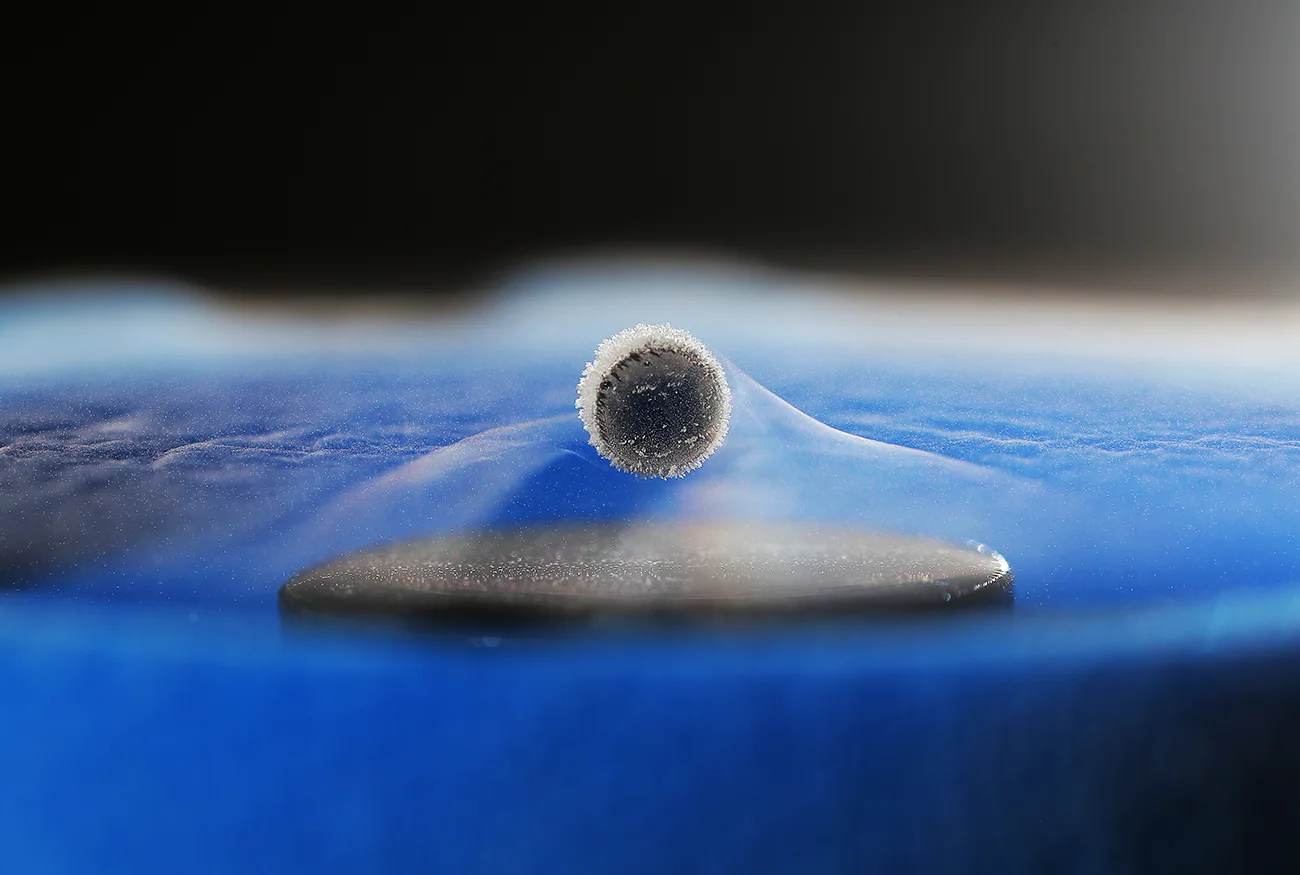
Superconductors are materials that, when cooled below a certain critical temperature, lose their electrical resistance and conduct electric current without energy loss.
Superconductors have promising applications in various high-tech industries where they can be used as part of lossless energy transmission systems, levitating high-speed trains, magnets for accelerators and thermonuclear reactors, ultra-high-performance microchips and quick-access memory devices for supercomputers, quantum computers, and diagnostic medical equipment.
Superconducting magnets are used in MRI devices to create strong magnetic fields required to obtain detailed images of internal organs.
Superconducting cables are used in power lines, wind turbines and accelerator magnets.
Market
The market for superconductors is expected to grow as research progresses, particularly in high-temperature superconductors (HTS).
The development of room-temperature superconductors could revolutionise sectors like power distribution, transportation and electronics, leading to substantial market expansion.
Additionally, advances in materials like palladium-based compounds could further enhance market growth by providing more efficient and cost-effective solutions.
Challenges of current technology
Superconductors are classified into low-temperature (LTS), operating at liquid helium temperatures near absolute zero (-273.15 °C or 0 K), and high-temperature (HTS), operating at higher temperatures, usually from the boiling point of liquid nitrogen (77 K) and upward, towards room temperature.
If any materials in existence were found to show superconductive properties at room temperature and standard atmospheric pressure, this could fundamentally change technology and power engineering.
Positive impact of palladium
Palladates, which are palladium-based ceramic materials, possess electronic configurations that might support high-temperature superconductivity. Researchers have identified the compounds RbSr2PdO3 and (Ba0.5La0.5)2PdO2Cl2 as holding some promise due to a potentially high critical transition temperature of about 100 K (with more palladium compounds on the radar). So far, however, their calculations have not been backed by any experimental evidence.
If the efforts put into synthesising these compounds yield the hoped-for results and the assumptions made about their properties are confirmed, palladium could become a highly sought-after metal in the superconductivity industry.
Ongoing research into palladium-based superconductors raises hopes of surpassing current critical temperature limits, positioning palladium as a key material in next-generation technologies.
To find out more about the physical qualities of palladium, see – Chemistry.
To find out more about superconductivity, see the following scientific publications:
Kitatani, M., Si, L., Worm, P., Tomczak, J. M., Arita, R., & Held, K. (2023). Optimizing superconductivity: from cuprates via nickelates to palladates. Physical Review Letters, 130(16), 166002. DOI: https://doi.org/10.1103/PhysRevLett.130.166002
Mouchou, S., Toual, Y., Azouaoui, A., Rezzouk, A., Bouslykhane, K., Hourmatallah, A., & Benzakour, N. (2024). Superconductivity properties of Pd-Heusler rare earth from ab initio and isotropic Eliashberg function. Physica C: Superconductivity and its Applications, 622, 1354517. DOI: https://doi.org/10.1016/j.physc.2024.1354517
Kawae, T., Inagaki, Y., Wen, S., Hirota, S., Itou, D., & Kimura, T. (2020). Superconductivity in palladium hydride systems. journal of the physical society of japan, 89(5), 051004. DOI: https://doi.org/10.7566/JPSJ.89.051004
Kim, S., Abdurakhimov, L. V., Pham, D., Qiu, W., Terai, H., Ashhab, S., … & Semba, K. (2024). Superconducting flux qubit with ferromagnetic Josephson π-junction operating at zero magnetic field. Communications Materials, 5(1), 216. DOI: 10.1038/s43246-024-00659-1
Benz, S., Hamilton, C., Burroughs, C., Harvey, T. and Christian, L. (1997), Stable 1 Volt Programmable Voltage Standard, Applied Physics Letter, 71 (13). DOI: https://www.nist.gov/publications/stable-1-volt-programmable-voltage-standard