


Fiberglass bushings
Current technology
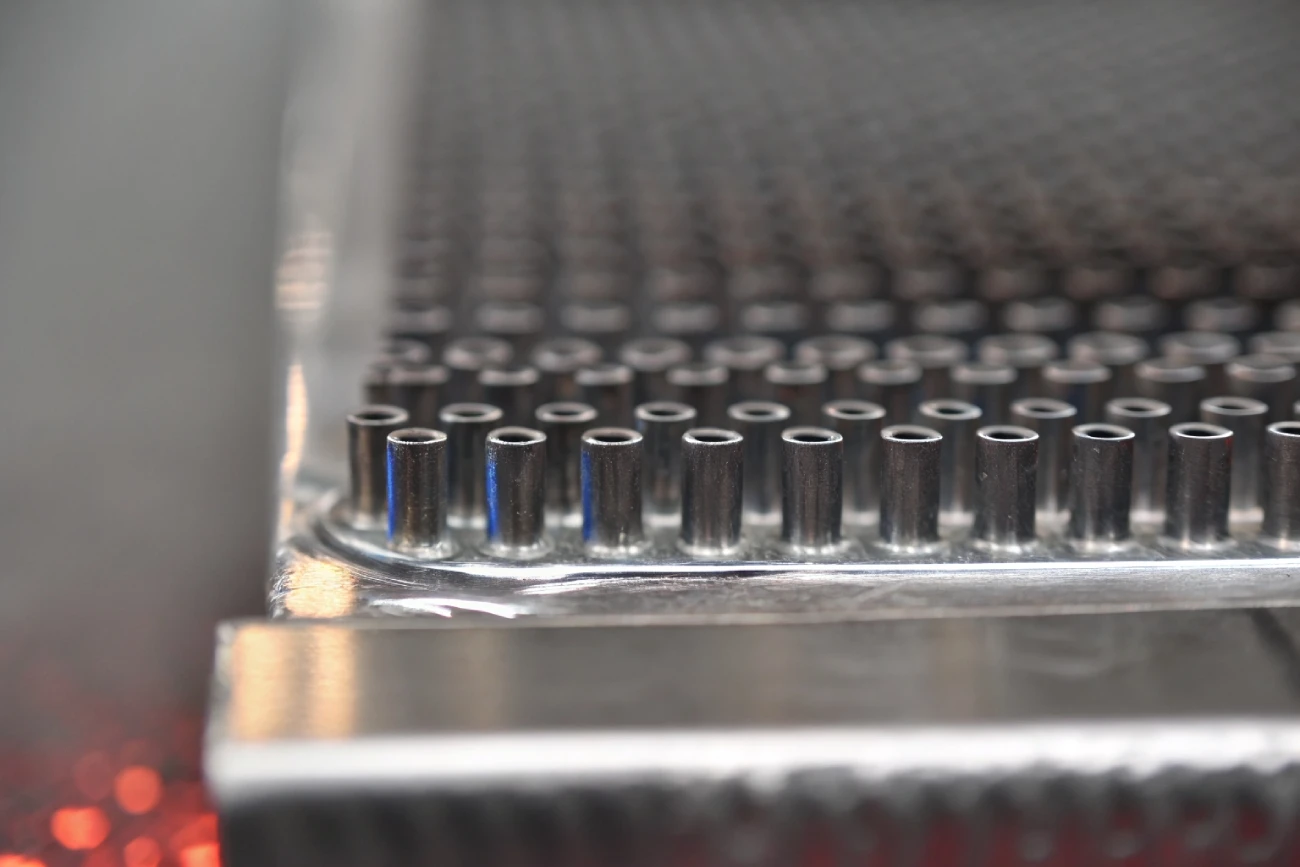
Currently, fibreglass bushings are primarily made using platinum and rhodium alloys due to their high strength, resistance to high temperatures and corrosion resistance. These alloys ensure that the final glass fibres meet the required quality standards, making them a worthwhile investment despite their high cost. The production process involves forming molten glass into fine fibres through a special furnace called a bushing, which is critical in determining the quality of the final product.
The bushing’s design is crucial as it must be tailored to the manufacturer’s specific requirements, including nozzle size, arrangement and number.
The current technology also involves heating bushing plates electronically to maintain precise temperature control, which is essential for producing high-quality glass fibres. This process allows for the production of fibres with varying diameters, depending on their intended use.
Incorrectly selected design and alloy parameters will make the temperature gradient uneven, reducing the quality of the fibreglass filaments.
Market
The market for fibreglass bushings is driven by the demand for high-quality glass fibres in various industries, including construction, the automotive industry and aerospace.
Demand for fibreglass products continues to grow, driven by their technical advantages such as strength, ductility and resistance to high temperatures.
This growth necessitates advances in bushing technology to meet the increasing demand for quality glass fibres. As a result, manufacturers are looking for innovative solutions that can improve efficiency and reduce costs.
Challenges of current technology
Despite the effectiveness of the current technologies, researchers and manufacturers alike are continually searching for more cost-effective and efficient materials that can enhance the production process.
One of the main challenges of current bushing technology is the high cost associated with using platinum and rhodium alloys. These materials are expensive, which can limit the adoption of fibreglass products in cost-sensitive applications. Additionally, the process of manufacturing bushings requires precise control over various parameters, which can be complex and energy-intensive.
The reliance on platinum alloys also exposes manufacturers to market fluctuations in the price of these metals, which can affect production costs and profitability. This volatility highlights the need for diversification in materials used for bushings.
Positive impact of palladium
Palladium could potentially be used in fibreglass bushings due to its lower density (half that of platinum), high strength, corrosion resistance, and ability to withstand high temperatures. This lower density makes it a more cost-effective material in terms of weight and volume, as it allows for the use of less material to achieve similar or even superior performance.
Palladium can also be dispersion-strengthened with the help of additives such as zirconium, which increases its physical strength.
These properties make palladium itself a promising alternative to pure platinum alloys or as a doping addition to mixed platinum-rhodium alloys, potentially offering a more cost-effective solution. Palladium’s chemical stability and resistance to oxidation won’t disrupt the durability of bushings.
To find out more about the metallurgical qualities of palladium, see – Chemistry.
To find out more about palladium in glass fibre production, see the following scientific publications:
- Chen, H., Xie, W., Liu, W. T., Wang, Z. Y., Yang, Z. L., Tang, H. Y., … & Xie, W. D. (2019). Research on high-temperature wettability between SiO2Al2O3CaOMgO glass melt droplets and platinum-rhodium alloy. Vacuum, 160, 445-452. DOI: https://doi.org/10.1016/j.vacuum.2018.12.012
- Zhang, S., He, X., Ding, Y., Shi, Z., & Wu, B. (2024). Supply and demand of platinum group metals and strategies for sustainable management. Renewable and Sustainable Energy Reviews, 204, 114821. DOI: https://doi.org/10.1016/j.rser.2024.114821