


Electrochemistry
Current technology
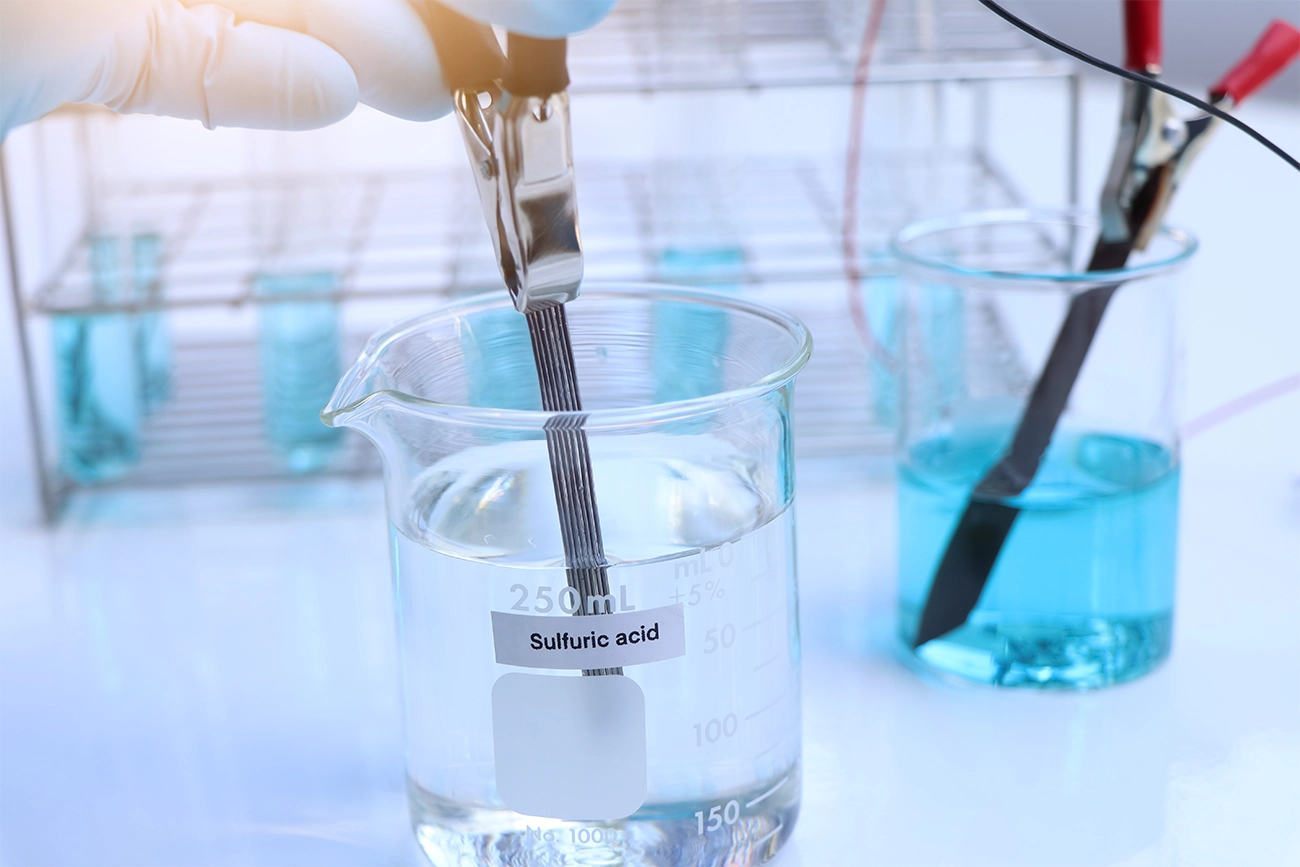
Electrochemistry is the branch of chemistry that explores the relationship between electrical energy and chemical changes. It studies the generation of electricity from the energy released during spontaneous chemical reaction, as well as non-spontaneous chemical transformations that require the application of electrical energy in order to occur.
In the applied sense, it is a common name for many processes and technologies where current flows between electrodes through some kind of medium:
- water and wastewater treatment;
- the chlor-alkali industry;
- production of cathode nickel, copper and other metals;
- corrosion protection;
- others.
These processes use electrodes of various shapes, compositions and coatings.
The following basic industrial anodes are widely used in various electrochemical processes:
- Lead plate doped with tin and calcium (Pb-Sn-Ca).
- Titanium plate coated with a mixture of platinum group metal oxides: iridium, ruthenium, platinum, rhodium – also called mixed metal oxide (MMO) anodes.
Market
It is quite difficult to cover all the markets for electrochemical processes, so we will limit ourselves to the main ones.
With population growth and the expansion of cities, there is a need for more efficient wastewater disinfection systems, including the use of MMO anodes, which do not require chemicals other than salt.
MMO anodes are gradually coming into use. New hydrometallurgy plants are being built to meet the high energy efficiency requirements that MMO anodes provide. Existing hydrometallurgy plants and other industries are switching to new MMO anodes as they are modernised.
Copper production by electrodeposition using MMO anodes is still relatively small, but will grow. Copper ore quality in the world as a whole is becoming poorer, necessitating a transition from the pyrometallurgy method to electrodeposition. The growth of AI, meanwhile, is driving the production of printed circuit boards (PCBs), which require copper – produced most energy efficiently using MMO anodes by electrodeposition.
There has also been an increase in niche electrochemical applications such as ballast water treatment. The tightening of water quality requirements for large displacement vessels forces owners to install purification systems. At the same time, it is not always profitable to transport the supply of chemicals necessary for the chlorination of water on a ship. On-site production of chlor-alkali from saltwater using MMO anodes looks like a promising solution.
Challenges of current technology
In most cases and applications, existing electrodes provide energy efficiency that a palladium solution could outcompete thanks to its unique property of high hydrogen reactivity.
Current electrodes can’t provide this ability to facilitate efficient reactions in hydrogen production, particularly in water electrolysis, as palladium electrodes do. Therefore, manufacturers are constantly looking for coating formulations to improve the energy efficiency of the process.
Also, existing anode coatings made of PGMs such as iridium are simply more expensive than palladium anode coatings, which provide sufficient resistance in electrochemical processes that electrolysis can occur under harsh conditions.
Positive impact of palladium
Palladium catalysts exhibit bifunctional activity in both oxygen and hydrogen evolution reactions, allowing high current density at low voltage. This reduces the energy consumption of electrolysers and makes hydrogen production more cost-effective.
Compared to catalytic coatings made from more expensive platinum group metals such as iridium, doping or substitution with palladium can be a cheaper replacement without significantly impairing the catalytic properties.
Moreover, palladium is highly effective in the decomposition of chlorine compounds. This application extends beyond industrial settings to household use, such as in water disinfection. Electrolysis of saltwater solutions using palladium-coated electrodes generates sodium hypochlorite on site, eliminating the need for transporting and storing large amounts of bleach. This process is environmentally friendly and convenient for various applications.
In printed circuit board (PCB) manufacturing, palladium compounds are used as catalysts for copper electroplating on non-conductive substrates. The palladium-coated areas serve as active sites for copper deposition, forming conductive tracks on the board. Palladium’s corrosion resistance ensures that specific areas of the PCB are protected from etching, facilitating the creation of complex circuits and improving the reliability and quality of the final product.
To find out more about the electrochemical qualities of palladium, see – Chemistry.
To find out more about palladium in electrochemistry, see the following scientific publications:
Chen, A., & Ostrom, C. (2015). Palladium-based nanomaterials: synthesis and electrochemical applications. Chemical Reviews, 115(21), 11999-12044.DOI: https://doi.org/10.1021/acs.chemrev.5b00324
Park, J. E., Kim, H., & Lee, E. S. (2020). Accelerated Life Testing of a Palladium-Doped Tin Oxide Electrode for Zn Electrowinning. Materials, 13(8), 1969. DOI: https://doi.org/10.3390/ma13081969
Altaf, A., Sohail, M., Nafady, A., Siddique, R. G., Shah, S. S. A., & Najam, T. (2023). Facile Synthesis of PdO. TiO2 Nanocomposite for Photoelectrochemical Oxygen Evolution Reaction. Molecules, 28(2), 572. DOI: https://doi.org/10.3390/molecules28020572
Antozzi, A. L., Brown, C. W., & Calderara, A. (2012). Novel DSA® anode for electrowinning of non ferrous metals. Electrometallurgy 2012, 35-40. DOI: https://doi.org/10.1002/9781118371350.ch3