


Biofuel
Current technology
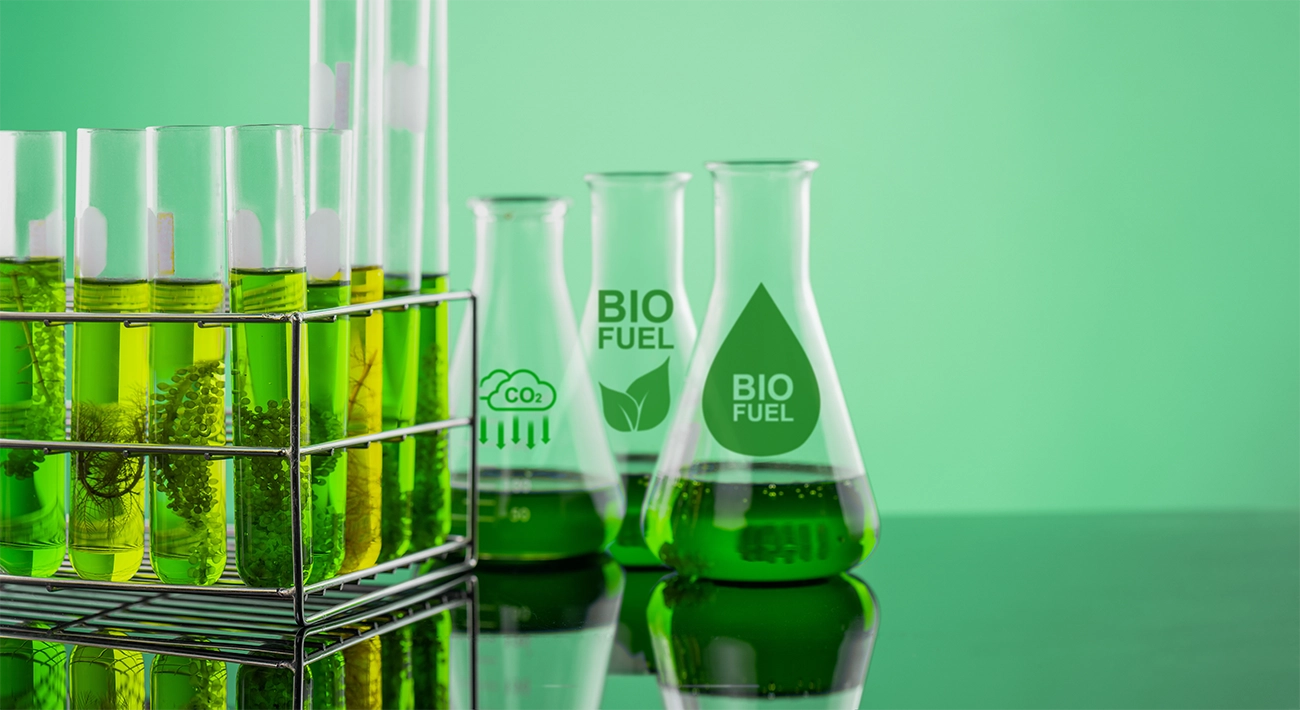
Biofuels are fuels produced from biomass, falling into two main classifications.
By aggregate state:
- Solid: pellets, briquettes, biochar, etc.
- Liquid: bioethanol, biodiesel, biobutanol, etc.
- Gaseous: biogas, hydrogen, etc.
By raw materials:
- From agricultural crops with a high content of fats, starch, and sugars.
- Of the lignocellulose compounds remaining after the parts of biological raw materials suitable for use in the food industry are removed.
- From microorganisms.
Along with the choice of raw materials, there are different processing methods: transesterification involves reactions of fatty acids and glycerides with methanol, while hydroprocessing involves hydrodeoxegenation reactions on heterogeneous catalysts.
The biocomponent obtained from plant raw materials is introduced into the composition of petroleum fuel or is used in its pure form as aviation fuel (sustainable aviation fuel, SAF) and diesel fuel (hydrotreated vegetable oil, HVO) with improved environmental characteristics.
Market
The demand for biofuel production is growing rapidly due to its critical role in reducing greenhouse gas emissions. According to a McKinsey report, the production capacity of liquid biofuels (HVO + SAF) was 12.1 million tonnes in 2023 and is expected to reach 49.2 million tonnes by 2030. This exponential growth reflects the increasing focus on renewable energy sources as part of global decarbonisation strategies.
Challenges of current technology
The actual problems of modern biofuels obtained through the transesterification reaction are poor compatibility with petroleum fuel, low chemical stability during storage, increased carbon formation in the combustion chamber of the engine, and unsatisfactory low-temperature properties.
Production of biofuels through hydroprocessing from vegetable oils, waste cooking fats and other biomaterials is the most promising way to obtain biofuels with properties that are not inferior to petroleum ones, while remaining neutral in relation to the environment.
The key challenges in biofuel production revolve around catalyst efficiency and the variety of feedstocks. Current technologies often rely on catalysts based on nickel, cobalt and molybdenum, which have proven themselves in these processes due to their satisfactory activity and low cost. Additionally, the variability in the composition of renewable raw materials, such as used cooking oils and vegetable oils, adds complexity to the hydroprocessing reaction, making it difficult to achieve consistent yields. Hydroprocessing of renewable feedstocks involves critical reactions like deoxygenation and denitrogenation. These processes aim to remove oxygen and other unwanted elements from triglycerides, yielding paraffinic hydrocarbons that resemble components of jet fuel or diesel fuel. However, maintaining catalyst efficiency and ensuring long-term stability remains a significant technical hurdle in scaling up biofuel production.
Positive impact of palladium
Palladium-based catalysts offer a promising solution to these challenges. Compared to traditional nickel- and cobalt-based systems, palladium catalysts exhibit superior activity and stability during the hydroprocessing of renewable feedstocks.
High catalytic efficiency enables faster deoxygenation reactions, leading to higher yields of paraffinic hydrocarbons.
Palladium’s unique properties also enhance the selectivity of hydroprocessing reactions, enabling the production of cleaner fuels with minimal byproducts. These characteristics make palladium catalysts an essential component in advancing the biofuel industry and achieving sustainable energy goals.
To find out more about the catalytic qualities of palladium, see – Chemistry.
To find out more about palladium catalysts in the biofuel industry, see the following scientific publications:
- Shu, R., Li, R., Lin, B., Wang, C., Cheng, Z., & Chen, Y. (2020). A review on the catalytic hydrodeoxygenation of lignin-derived phenolic compounds and the conversion of raw lignin to hydrocarbon liquid fuels. Biomass and bioenergy, 132, 105432. DOI: https://doi.org/10.1016/j.biombioe.2019.105432
- Chauhan, A. S., Kumar, A., Bains, R., Kumar, M., & Das, P. (2024). A comprehensive study of palladium-based catalysts on different supports for the hydrogenolysis of 5-hydroxymethylfurfural (HMF) to 2, 5-dimethylfuran (DMF) biofuel. Biomass and Bioenergy, 185, 107209. DOI: https://doi.org/10.1016/j.biombioe.2024.107209
- Srihanun, N., Dujjanutat, P., Muanruksa, P., & Kaewkannetra, P. (2020). Biofuels of green diesel–kerosene–gasoline production from palm oil: effect of palladium cooperated with second metal on hydrocracking reaction. Catalysts, 10(2), 241. DOI: https://doi.org/10.3390/catal10020241