


Solar energy
Current technology
Solar energy is a rapidly growing sector in the renewable energy landscape, with photovoltaic (PV) systems playing a crucial role in converting sunlight into electricity.
The technology behind solar cells has evolved significantly over the years, leading to the classification of solar cell technologies into different generations based on their materials and efficiency.
In the field of photovoltaics, it is common to divide solar cell technologies into three generations:
- The first generation is based on the use of mono- or polycrystalline silicon.
- The second generation is thin-film: amorphous silicon PVs, as well as cadmium telluride (CdTe), indium gallium copper selenide (CIGS) and gallium arsenide (GaAs) technologies.
- The third generation is still at the stage of scientific research and pilot production. These technologies include multijunction solar cells, perovskite solar cells (hereinafter referred to as PSE), quantum dot solar cells, and organic photovoltaic cells.
First-generation solar cell technology is the most common in the solar energy industry.
Now, the industry has developed the production of several first-generation solar system architectures. In the coming years, the main production technologies will be TOPCon and HJT:
- Tunnel oxide passive contact (TOPCon) involves the addition of an ultra-thin oxide layer on the back of the cell, which helps improve light capture and overall efficiency. TOPCon technology can achieve a theoretical maximum efficiency of about 23.7%.
- Heterojunction technology (HJT) uses alternating layers of crystalline and amorphous silicon, which allows cells to absorb a wider range of light waves. This makes them one of the most efficient on the market, with a theoretical efficiency limit of over 26.7%, although current models reach about 24%.
- Aluminium back surface field (Al-BSF) includes the creation of an aluminium layer on the back surface of the solar cell, which helps to reduce the rate of recombination of charge carriers. This is achieved due to the high concentration of alloying elements in the back layer, which improves the efficiency of solar energy conversion by up to 20% and above.
- Passivated emitter and rear cell (PERC) is an improved version of standard solar cells. In this technology, a dielectric layer with micro-holes is added between silicon and aluminium on the back of the cell, which allows light to be reflected back into the cell and increases its efficiency. This technology can increase the efficiency of cells by 1–2% compared to traditional methods.
- Interdigitated back contact (IBC) is distinguished by the fact that all contacts are located on the back of the cell, which allows the front surface to fully absorb sunlight without being shaded by metal conductors. This significantly increases the efficiency of converting light into electricity.

Market
As countries worldwide strive to meet their energy needs sustainably, solar energy is expected to play a pivotal role.
With the International Energy Agency (IEA) projecting that solar will account for nearly half of global electricity demand growth through 2025, the market is set to expand rapidly, supported by a shift towards cleaner energy sources and favourable government policies.
Technological innovations in photovoltaic systems are enhancing efficiency and reducing costs, making solar energy more accessible to consumers and businesses alike. The development of advanced solar cell technologies, such as tunnel oxide passive contact (TOPCon) and heterojunction technology (HJT), is expected to drive further improvements in energy conversion rates. This trend will likely lead to an increase in both large-scale solar installations and residential rooftop systems, contributing to a more diversified energy mix and greater energy independence.
Challenges of current technology
The current problems of modern TOPCon and HJT are brittle coating. To coat the latter with a transparent conductive layer, ITO (alloy (In2O3)0.9(SnO2)0.1) is usually used, which is quite brittle and does not support the manufacture of flexible coatings.
Positive impact of palladium
For these technologies, there is still room for the optimisation of conductive and passivation coatings.
As a semiconductor-ready material capable of forming stable and durable compounds, palladium, particularly in the form of chalcogenides (e.g. palladium diselenide, PdSe2), shows great promise for next-generation solar panels. Palladium-containing solar panels are a relatively new focus area in photoelectric research.
Panels based on palladium diselenide effectively absorb solar radiation and generate electric current via the photoelectric effect. The key advantages of palladium diselenide over other light-converting materials are its ability to undergo structural modifications and its high mobility of charge carries (electrons and holes). These proprieties enable it to generate and transport large currents, significantly enhancing solar cell performance.
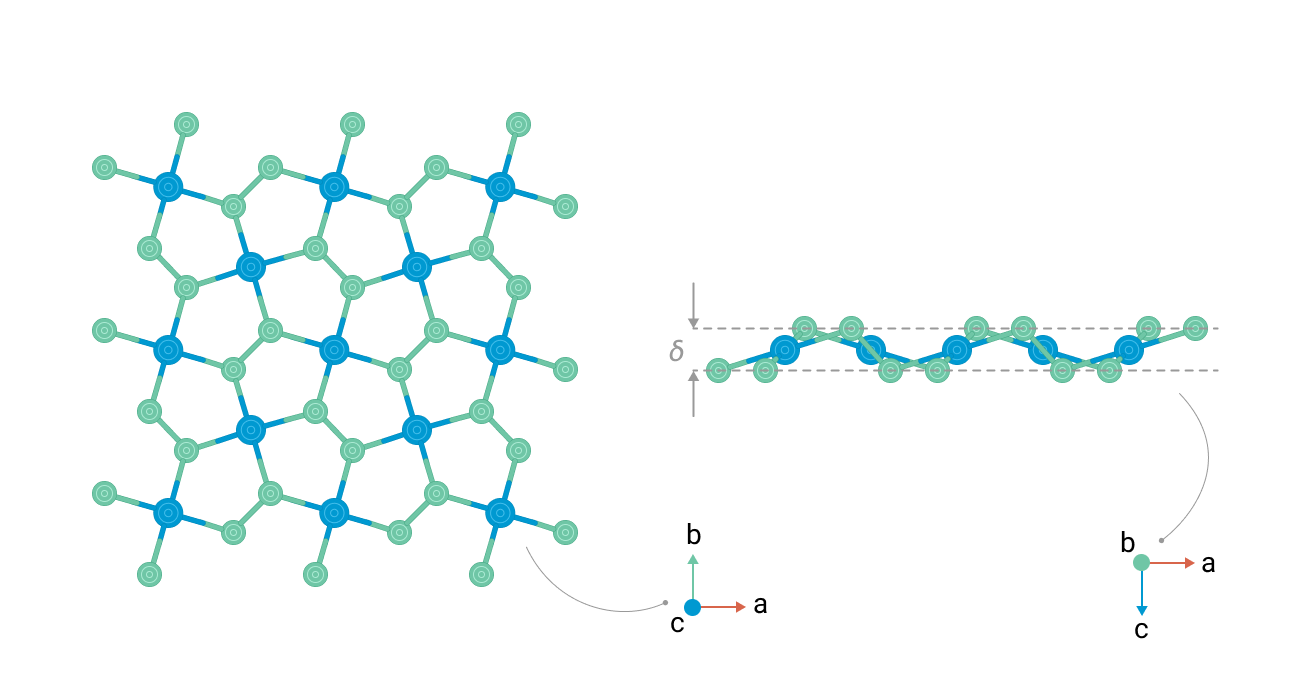
Crystalline structure of palladium diselenide, PdSe2. The green and spheres designate palladium and selenium atoms, respectively.
Palladium is relatively expensive compared to materials such as silicon and copper, but its compounds justify their cost through high efficiency and unique properties. For example, palladium chalcogenides can be synthesised and applied onto substrate surfaces at relatively low temperatures, making solar cell production both cheaper and more environmentally friendly. These compounds also outperform many other semiconductors (known to contain toxic elements) in terms of environmental safety. Panels made with palladium chalcogenides are suitable for end-of-life recycling.
Palladium chalcogenides can form various nano-sized structures, making them suitable for thin-film coatings or nanofibres, while remaining stable and durable compared to some other semiconductor materials. This feature opens up opportunities for creating flexible or intricately shaped solar panels using palladium diselenide into organic panels.
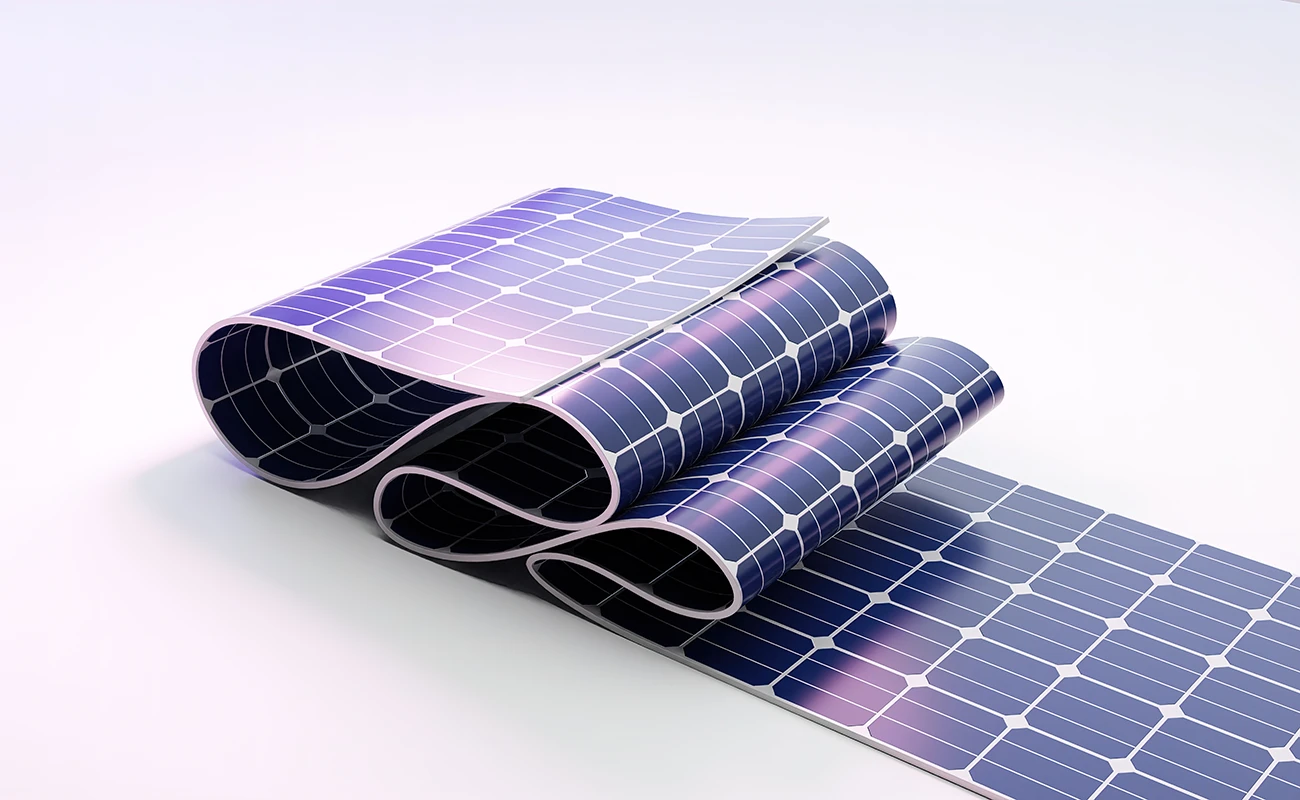
To support the production of flexible solar panels, ITO could be replaced by a so-called DMD (dielectric-metal-dielectric) layer. In this layer, palladium may act as a transparent metal that helps to overcome the brittleness of ITO.
PSE is in pole position when it comes to novel solar conversion technologies. Here, palladium could play a role in enhancing PSE performance and stability thanks to the use of PdSe2. In the form of nanosheets, this material has an indirect band gap of about 1.34 eV, which ensures the effective absorption of sunlight in the range from 300 to 1,100 nm. In the configuration of thin films, PdSe2 demonstrates stability at elevated temperatures up to 400 °C. In addition, the effect of quantum limitation is observed, leading to a narrowing of the band gap to 0.03 eV.
The most promising areas for palladium applications in PSE:
– The use of optically active nanoscale to improve the optical properties of thin films.
– Creation of ultra-thin conductive and translucent layers for collecting photo carriers as an alternative to expensive materials such as ITO and FTO.
– Development of p-type charge transfer layers.
To find out more about the physical and chemical qualities of palladium, see – Chemistry
To find out more about palladium in photovoltaics, see the following scientific publications:
- Oyedele, A. D., Yang, S., Liang, L., Puretzky, A. A., Wang, K., Zhang, J., … & Xiao, K. (2017). PdSe2: pentagonal two-dimensional layers with high air stability for electronics. Journal of the American Chemical Society, 139(40), 14090-14097. DOI: https://doi.org/10.1021/jacs.7b04865
- Zhang, J., Liu, G., Yuan, J., Liao, X., & Zhou, Y. (2025). Enhanced Photoresponse in PdSe2 via Local Plasma Treatment: Implication for Advanced Optoelectronic Devices. ACS Applied Nano Materials. DOI: https://doi.org/10.1021/acsanm.4c06731
- Ghosh, D. K., Bose, S., Das, G., Acharyya, S., Nandi, A., Mukhopadhyay, S., & Sengupta, A. (2022). Fundamentals, present status and future perspective of TOPCon solar cells: A comprehensive review. Surfaces and interfaces, 30, 101917. DOI: https://doi.org/10.1016/j.surfin.2022.101917
- Aziz, N. A. S., Rahman, M. Y. A., Umar, A. A., & Mawarnis, E. R. (2023). Palladium films as cathode in dye-sensitized solar cell: influence of the concentration of potassium hexachloropalladate. Applied Physics A, 129(11), 816. DOI: https://doi.org/10.1007/s00339-023-07104-z