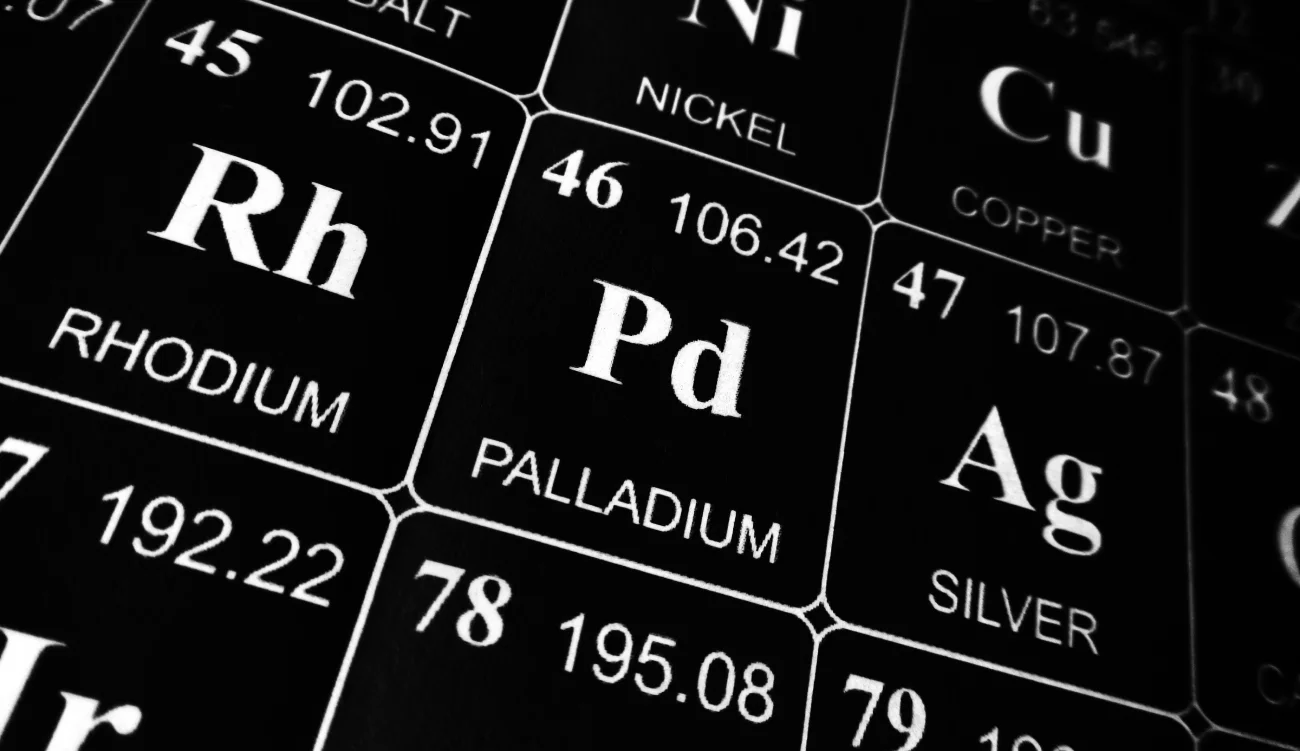
Palladium core
Palladium (Pd) is an element that occupies the 46th position in the periodic table. It is categorised as a transition metal and is part of the group of d-block elements. Palladium is distinguished by its inherent properties, and is categorised as a noble metal, along with other metals within the platinum group (platinum, ruthenium, rhodium, osmium, iridium), as well as silver and gold. These metals possess a number of crucial properties that are indispensable for industrial applications.
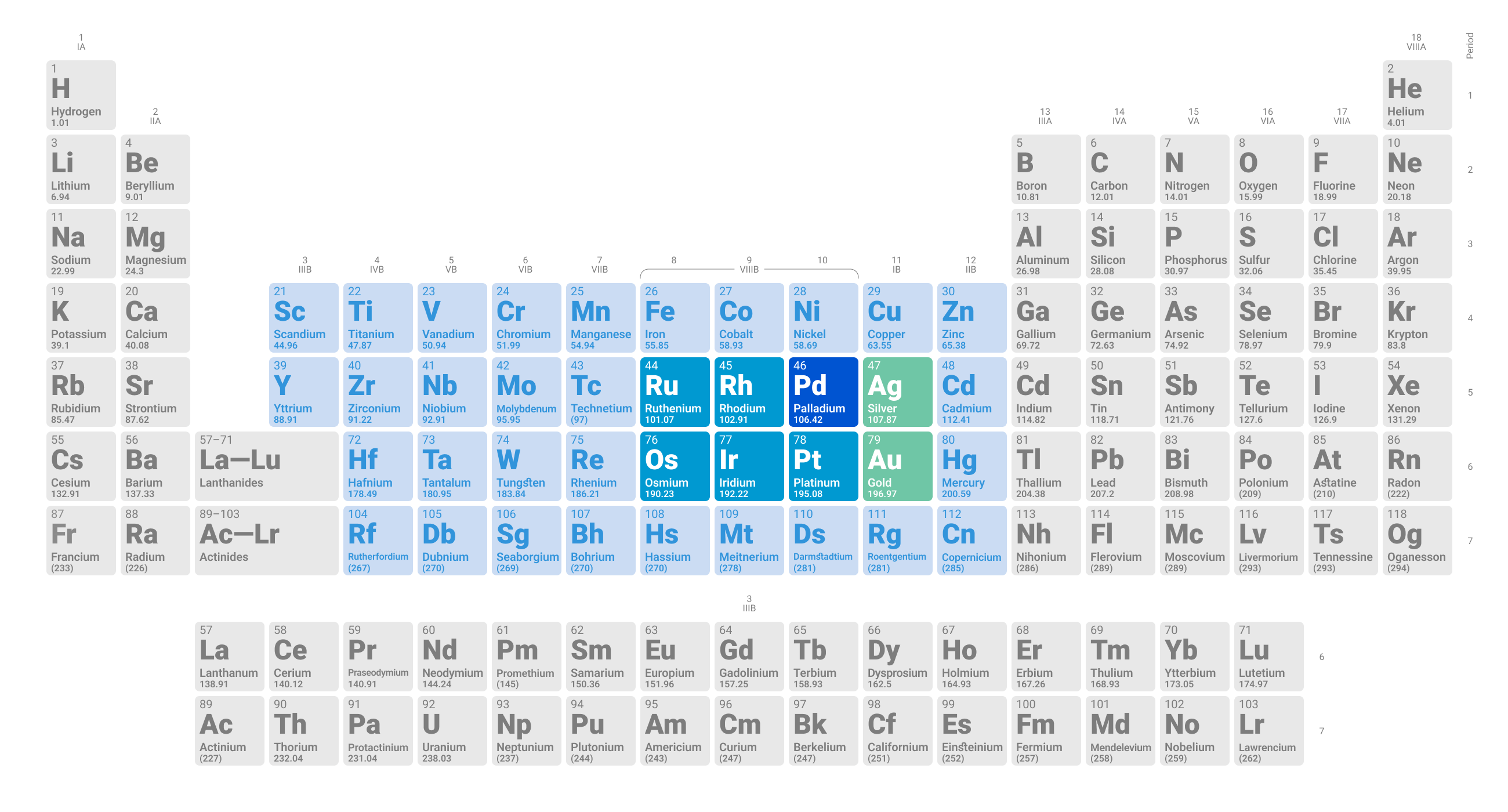
In common with all metals in its group, palladium exhibits excellent reflectivity, giving it a distinctive metallic sheen. It is both thermally and electrically conductive, and is a refractory metal that is remarkably ductile, hard and strong. In addition to the properties typical of transition metals, palladium, like all platinoids, exhibits special properties, including a high degree of chemical inertness, particularly resistance to oxidation even at high temperatures, high corrosion resistance, the ability to form complex compounds, and a high melting point. Like all platinoids, palladium is also an excellent catalyst for many chemical reactions. Because of its unique structure, however, palladium differs in many respects from both other transition metals and platinum group metals, which makes it indispensable in many branches of modern industry with the potential for further applications.
Related content
Chemistry
The distinctive properties of palladium are rooted in the unique configuration of its outer electron shell, which is distinct from that observed in other transition metals. Palladium stands out as the sole member of the d-block elements that exhibits a fully occupied outer shell. Typically, transition metals possess one or two electrons in their outer shell. In palladium, however, both electrons from the 5s orbital 'slipped' to the lower 4d orbital.
Find out more 
Reserves & mining
Platinum group metals (PGMs) are among the rare elements and they occur in the same deposits. The extraction of these metals takes place in only a few countries worldwide, with total estimated reserves of approximately 2.3 billion troy ounces. Among PGMs, palladium is the most abundant, followed by platinum, both of which are highly valued for their industrial applications.
Find out more
Prices
Palladium is the most produced metal among the platinum group metals (PGMs). Unlike other PGMs, its extraction is less concentrated and primarily takes place in two major regions – South Africa and Russia. This diversified supply chain reduces the risk of significant disruptions and ensures a more stable flow of palladium to the market. As a result, palladium generally has a lower average price compared to other PGMs.
Find out more
Life cycle
The journey of palladium begins deep underground. Major deposits of this precious metal are found in South Africa, Russia, Canada and the United States. Depending on the depth of the ore, extraction methods include open-pit mining or underground mining in shafts.
Find out more